
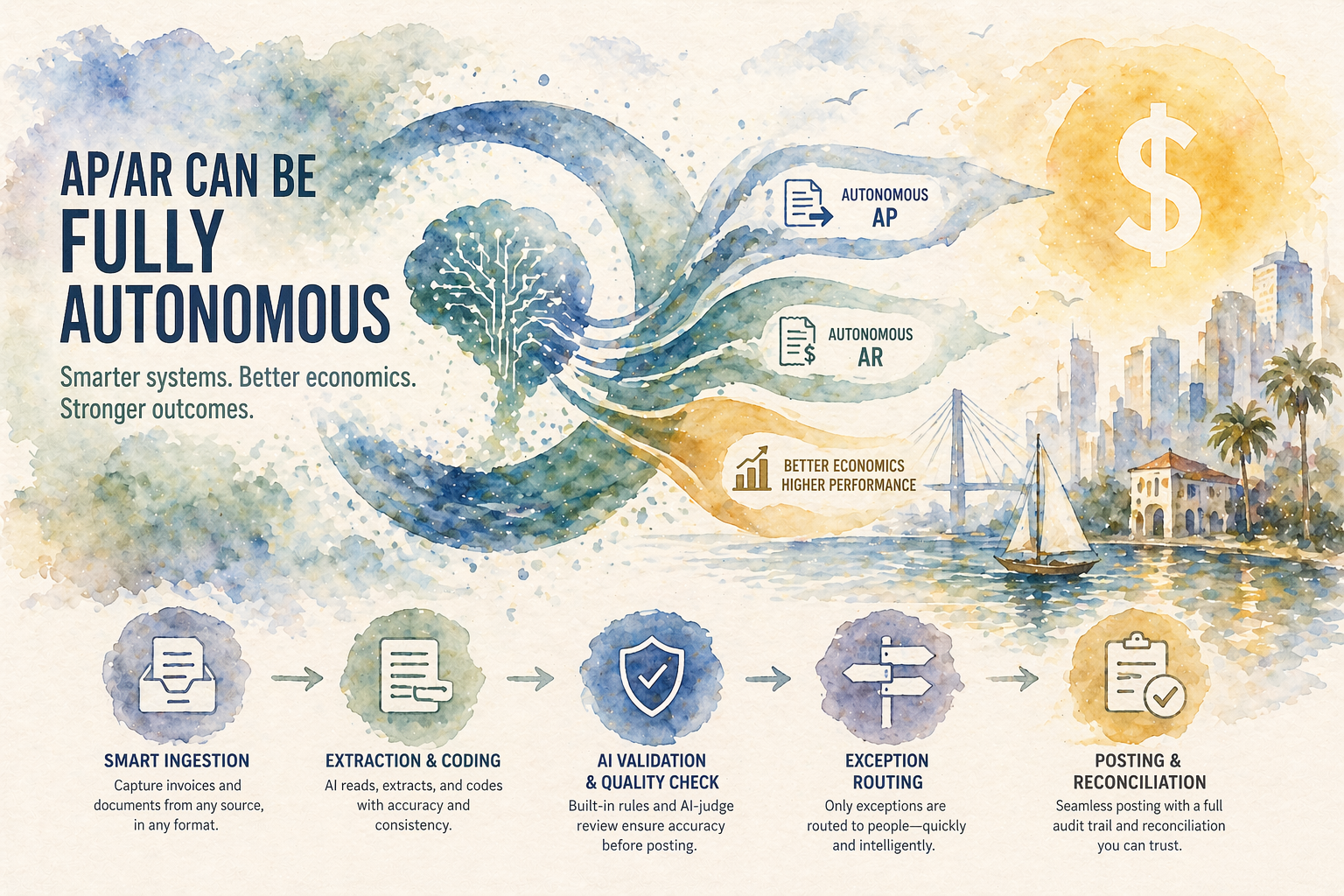
AP/AR Can Be Fully Autonomous
There is a lot of noise around “AI-powered finance,” and most of it centers on what the technology is capable of doing. Can a model read invoices? Can it code transactions? Can it follow up on receivables?
Those are reasonable questions, but they are not the ones that matter most. The more important question is whether autonomy actually improves how a finance operation performs. If it does not reduce cost, increase speed, improve accuracy, or make the operation easier to scale, then it is not particularly valuable, regardless of how advanced it sounds.
AP and AR can become highly autonomous. That is no longer hypothetical. But it only works in practice when the focus shifts away from the tools themselves and toward the economics and the system design behind them.
What “Fully Autonomous” Actually Means
It helps to be precise about the claim. Fully autonomous does not mean that an AI system handles every edge case perfectly with no oversight. In practice, that is not how real operations work.
A more useful definition looks like this:
- Routine work flows through the system without human involvement
- Clean, repeatable transactions are processed end-to-end automatically
- Humans are involved only when something is:
- ambiguous
- high-risk
- policy-sensitive
- low-confidence
This distinction matters because it sets the right target. The goal is not perfection across every scenario. The goal is to eliminate unnecessary human touch on the majority of work while preserving control where it actually matters.
The Economic Lens for AP/AR
If autonomy is going to be meaningful, it needs to show up in the core metrics of the operation.
On the AP side, that typically includes:
- Cost per invoice processed
- Time from receipt to posting
- Staff time required as volume increases
On the AR side, it includes:
- Time to generate and collect receivables
- Frequency of disputes or corrections
- Effort required for follow-ups and reconciliation
There are also secondary effects that are easy to underestimate:
- Errors in coding or data entry that create downstream cleanup work
- Delayed invoices that impact reporting accuracy
- Missed or incorrect charges that reduce revenue or create friction
Any serious discussion of autonomous AP/AR should be grounded in these realities. If a system does not improve these outcomes in a measurable way, then it is not solving the right problem.
Where Autonomy Actually Creates Economic Value
When autonomy is applied in the right context, the impact is not limited to labor savings. The gains tend to come from several areas that reinforce each other.
1. Labor efficiency and scalability
High-volume, repetitive tasks can move from manual handling to straight-through processing. This allows teams to:
- Handle more volume without scaling headcount linearly
- Shift focus toward exceptions and higher-value decisions
- Reduce time spent on repetitive entry and coordination
2. Faster cycle times
Automation reduces delays between steps. In practice, that means:
- Invoices are ingested, interpreted, and routed faster
- Receivables are generated and progressed without waiting on manual intervention
- Operational flow becomes more predictable
In some cases, this also improves cash timing, especially on the AR side.
3. Higher accuracy and consistency
Manual processes introduce variability. Even experienced teams make occasional errors, and different individuals may apply logic slightly differently.
A well-designed autonomous system:
- Eliminates “fat-finger” errors in amounts, dates, and codes
- Applies business logic consistently across all transactions
- Reduces rework and downstream correction effort
It’s not about perfection. It’s about materially reducing avoidable error and variance.
4. Automated quality control
One of the less obvious advantages is that the system can evaluate its own work.
Instead of relying on manual spot checks, you can introduce validation layers that check:
- Field completeness
- Internal consistency (e.g., totals match line items)
- Alignment with business rules
- Deviations from historical patterns
This can include:
- Rule-based validation
- Confidence thresholds
- A secondary “AI judge” layer to review outputs
Transactions that pass these checks move forward automatically. Anything questionable is flagged for review. This creates a review process that scales with volume without requiring proportional human effort.
5. Compounding economic impact
Each of these improvements matters on its own, but the real value comes from how they combine:
- Labor savings
- Faster throughput
- Higher accuracy
- Scalable validation
Together, they create a system that is not just cheaper, but more reliable and easier to scale.
Why Most “Autonomous AP/AR” Efforts Fall Short
If the upside is this clear, it raises a reasonable question: why doesn’t this work everywhere?
In most cases, the issue is not that the underlying technology is incapable. It is that the problem is treated as a tool selection exercise rather than a system design challenge.
Typical failure points include:
- Inconsistent document formats across vendors or customers
- Weak or incomplete master data
- Informal or undocumented coding logic
- Fragmented systems that do not integrate cleanly
- Approval processes that rely on context not captured in the system
- Exception handling that depends on tribal knowledge
When an AI tool is introduced into this environment, it does not eliminate the complexity. It exposes it. The result is usually:
- High exception rates
- Frequent corrections
- Continued reliance on manual intervention
This Is a System Design Problem
To get meaningful autonomy, the focus has to shift from the model to the system as a whole.
AI is important, particularly for:
- Interpreting unstructured data
- Classifying transactions
- Handling variability
But it is only one component. The overall system determines whether the process works reliably at scale.
Well-designed systems:
- Assume variability exists
- Define clear paths for both standard cases and exceptions
- Minimize unnecessary human involvement
- Preserve control and auditability
What an Autonomous AP/AR System Actually Requires
An effective system is not a single tool. It is a coordinated set of components working together.
1. Ingestion
- Capture inputs from email, portals, uploads, EDI, or integrations
- Route them into a consistent processing pipeline
- Normalize where possible
2. Extraction and interpretation
- Read invoices, remittances, and supporting documents
- Extract structured data from unstructured inputs
- Classify transaction type, vendor/customer, and category
3. Business logic and coding
- Map transactions into:
- GL accounts
- entities or properties
- vendors or customers
- charge types
This is where many implementations break. If the logic is unclear or inconsistent, everything downstream suffers.
4. Validation and AI-assisted review
- Apply rule-based checks
- Use confidence scoring
- Compare against historical data
- Detect duplicates or anomalies
This layer determines whether a transaction:
- proceeds automatically
- or is routed for review
5. Approvals and exception handling
- Define clear criteria for when human involvement is required
- Route exceptions to the right person or team
- Avoid broad, unnecessary manual review
6. Posting, reconciliation, and audit trail
- Write transactions back to the system of record
- Maintain a clear log of:
- what happened
- why it happened
- how confident the system was
This is critical for both operational trust and financial accountability.
The Real Lever Is the Exception Rate
One of the most important practical insights is that the goal is not to reach 100 percent autonomy.
In most real-world scenarios:
- A system that achieves 80–90% straight-through processing delivers the majority of the value
- The remaining 10–20% needs to be handled cleanly and efficiently
The exception rate becomes the key driver of performance:
- Lower exception rate → less manual work
- Better exception routing → less friction
- Clear review logic → faster resolution
Trying to eliminate every exception often leads to unnecessary complexity. Designing for efficient exception handling produces better outcomes.
Where to Start
Not all workflows are equally suited for autonomy, especially early on.
Strong starting points include:
- Utility invoices
- Recurring vendor invoices
- Standardized payables
- Routine customer or resident charges
These tend to share:
- High volume
- Clear rules
- Consistent formats
Poor early candidates include:
- Highly variable invoices
- Dispute-heavy receivables
- Workflows with unclear or evolving logic
- Cases requiring frequent human judgment
Starting with the right workflows makes it easier to:
- demonstrate value quickly
- reduce risk
- build confidence in the system
Closing
AP and AR can become highly autonomous, but not because AI is inherently capable of replacing every human task. The results come from redesigning how the work flows through the system.
The most effective implementations:
- focus on improving cost, speed, accuracy, and scalability
- use AI where it adds real value
- design systems that handle both standard work and exceptions cleanly
The goal is not to remove humans entirely. It is to ensure that human time is spent where judgment actually matters, while everything else runs as efficiently and consistently as possible.