
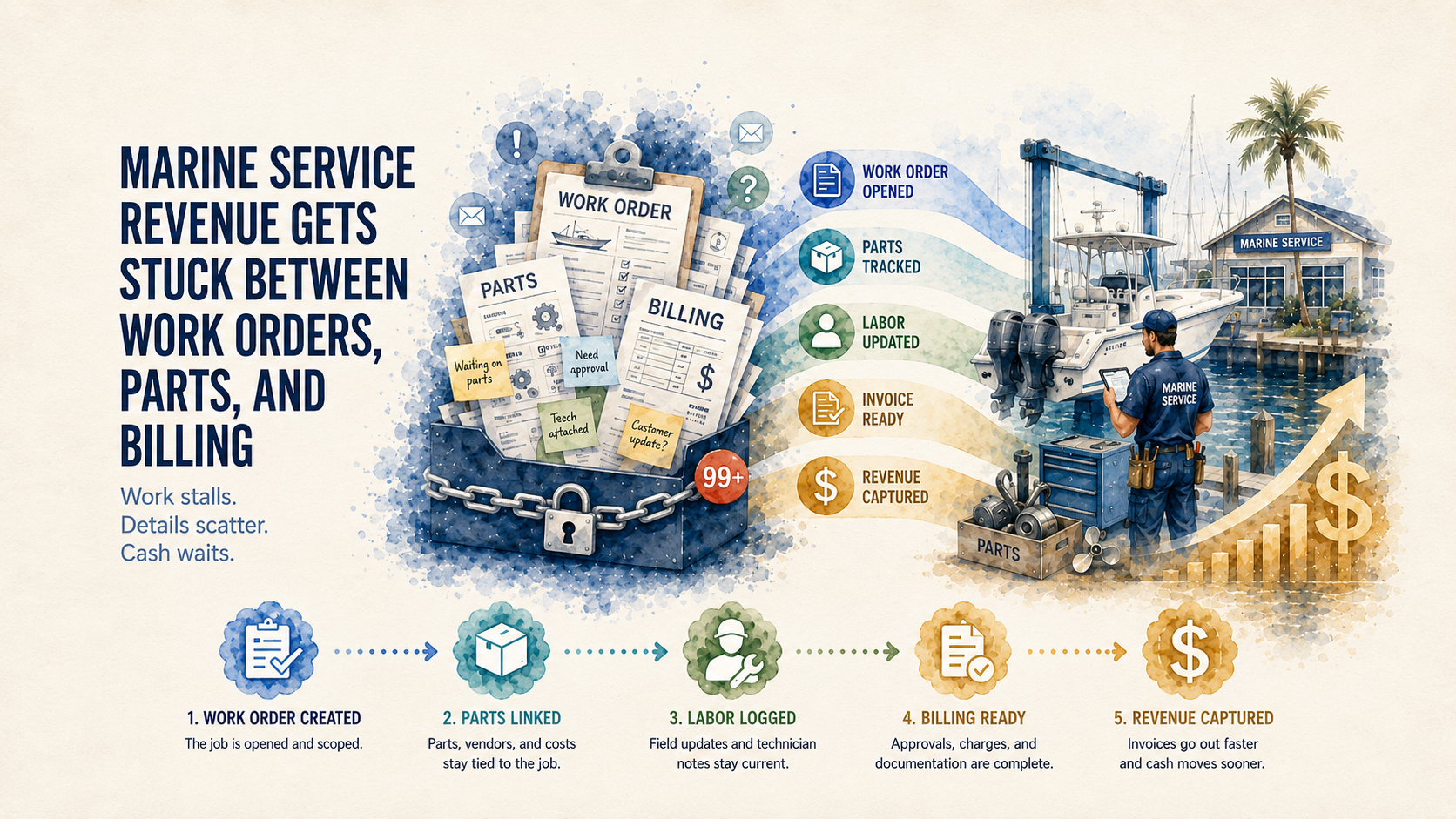
A service-heavy marina or boatyard can have plenty of demand and still leave revenue sitting unfinished.
The customer approves the work. The technician diagnoses the issue. Parts get ordered. A note gets added somewhere. The boat waits in the yard, at the dock, or on the schedule. Eventually the work may be complete, but the invoice is not ready because the labor notes, parts charges, approvals, photos, or final status are scattered across systems and people.
That is not a software problem in the simple sense. Most marine operators already have tools for service, accounting, storage, slips, parts, reservations, payments, or customer communication. The issue is usually the workflow layer between those tools.
For marinas, boatyards, yacht service companies, and rental fleets, the best automation opportunity is often not replacing the system of record. It is making stuck work visible, moving exceptions to the right person, and helping the team close the gap between work performed and revenue billed.
The Problem
Marine service work is operationally messy by nature.
A single job can involve a service writer, technician, parts counter, yard crew, customer, manager, and accounting. The work may depend on haul-out timing, weather, parts availability, customer approval, technician notes, warranty questions, or discovery after the boat is opened up.
That complexity is normal. The breakdown happens when job status depends on manual follow-up and local knowledge.
Common failure points include:
- Work orders waiting on parts without a clear next action
- Jobs waiting on customer approval after the scope changes
- Completed technician work that is not fully documented
- Parts installed on a boat but not tied cleanly back to the job
- Customer updates handled through one person's inbox or text messages
- Accounting waiting on service notes before an invoice can be sent
- Owners lacking a reliable view of backlog, work in progress, and completed-not-billed revenue
These problems are easy to underestimate because no single missed step looks catastrophic. One job waits an extra day for a note. Another waits for someone to confirm a part. Another is effectively complete but not invoiced because the final review has not happened.
Across a busy season, those small delays become real money.
Why This Gets Expensive
Marine service revenue leakage often hides inside the handoffs.
The business may be busy. Technicians may be productive. The yard may be full. But if work does not move cleanly from request to diagnosis, approval, parts, completion, and billing, the company can still lose margin and cash flow.
There are several costs.
First, completed work can sit unbilled. This is especially painful in service departments where labor, parts, subcontracted work, yard time, or storage-related charges need to be assembled before the invoice goes out. If the final package is incomplete, billing waits.
Second, staff spend too much time reconstructing status. A manager asks what is happening with a boat. The answer requires checking the service system, asking the technician, looking for a parts update, searching an inbox, and confirming whether the customer approved the revised scope. That is expensive coordination work.
Third, customer communication gets uneven. Boat owners usually understand that parts delays, weather, and service complexity are real. What frustrates them is silence, unclear status, or having to call repeatedly for an update. Poor communication can turn a normal operational delay into a relationship problem.
Fourth, owners lose visibility. A marine service business should be able to answer practical questions quickly:
- Which jobs are waiting on parts?
- Which jobs are waiting on customer approval?
- Which boats are complete but not ready to invoice?
- Which technicians have open notes or labor entries missing?
- Which jobs have been idle too long?
- Which departments are creating the most billing exceptions?
If those answers depend on asking around, the business is being managed from memory instead of a reliable operating view.
What a Better Workflow Looks Like
A better workflow does not require every marina or boatyard to change its core software. In many cases, that would be the wrong starting point.
The better starting point is a status layer that makes the real service process visible.
Each job should have a clear path:
- Service request received
- Job opened and assigned
- Diagnosis or estimate prepared
- Customer approval captured
- Parts or materials status tracked
- Work completed
- Technician notes and labor confirmed
- Billing review completed
- Invoice sent or queued
The value comes from making exceptions obvious. A normal job should move forward without extra meetings. A stuck job should appear in the right queue with a clear reason: waiting on parts, waiting on approval, missing notes, incomplete labor, billing exception, customer update needed, or manager review required.
This is different from a generic dashboard. A useful marine service dashboard does not just show totals. It tells operators where attention is needed.
For example:
- A parts-waiting list should show the boat, job, needed part, order status, expected date, and owner of the next action.
- An approval-delay queue should show the estimate, last customer contact, age of the request, and whether a follow-up draft is ready.
- A completed-not-billed report should show jobs marked complete but missing labor, parts, review, or invoice status.
- A customer update queue should identify jobs that have had no customer-facing update after a defined period.
The goal is not more reporting for its own sake. The goal is to shorten the distance between "something is stuck" and "the right person knows exactly what to do next."
Where AI Actually Helps
AI is useful in marine service operations when it helps turn messy operational information into structured, reviewable work.
Good uses include:
- Summarizing technician notes into a clean internal job update
- Drafting customer status messages from approved facts
- Classifying emails as approval, parts question, scheduling issue, billing question, or complaint
- Extracting job details from forms, service requests, photos, or messages
- Flagging jobs that appear complete but are missing billing inputs
- Turning unstructured notes into structured fields for human review
- Preparing manager summaries of backlog, stuck jobs, and completed-not-billed work
For example, if a technician notes that a bilge pump replacement is complete but also mentions a corroded connection that may need customer approval, AI can help separate the completed task from the new recommended work. The system can draft an internal summary, flag the approval need, and prepare a customer update for review.
That is useful because the AI is not making the business decision. It is reducing the clerical drag around the decision.
The strongest pattern is simple: automation manages the workflow state, while AI helps interpret the unstructured communication inside that workflow. Together, they make the operation easier to see and easier to manage.
Where Humans Should Stay Involved
Marine service work has too many high-trust moments for blind automation.
Humans should stay involved in:
- High-dollar estimates and revised scopes
- Customer disputes or frustration
- Warranty decisions
- Safety-related repairs
- Insurance matters
- Refunds, credits, or goodwill adjustments
- Final approval of sensitive customer messages
- Any decision that changes what the customer owes
The right system should not pretend otherwise. It should prepare better information, draft routine communication, route exceptions, and keep the record clean. A manager, service writer, technician, or accounting lead should still make the judgment calls.
This is especially important in owner-operated or relationship-driven marine businesses. Customers are often trusting the team with expensive assets, seasonal plans, and limited time on the water. Automation should make the team more responsive and organized, not make the experience feel colder.
A Practical Starting Point
The best first project is usually a focused revenue leakage workflow, not a full operational rebuild.
For a service-heavy marina or boatyard, a strong starting scope would be a completed-not-billed and stuck-job dashboard.
That project might include:
- A daily list of jobs marked complete but not invoiced
- Reasons each job is blocked, such as missing labor, missing parts, missing approval, or billing review
- A queue of jobs waiting on parts or customer approval
- Aging rules for idle work orders
- Customer update prompts when a job has gone quiet too long
- A weekly owner summary showing backlog, stuck revenue, and billing exceptions
This can often begin with exports, reports, inbox data, spreadsheets, or lightweight integrations before any deeper system work is attempted. The first goal is visibility and discipline, not technical elegance.
Once the business can see where revenue gets stuck, it can decide what to automate next. That may be parts delay alerts, customer approval follow-up, technician note cleanup, service writer queues, or accounting handoffs.
The important point is to start where the workflow pain is already measurable.
Final Thought
Marine service businesses do not need AI because AI is fashionable. They need better systems because the work is complex, seasonal, high-value, and easy to lose track of when the team gets busy.
The biggest opportunity is often between the systems already in place. Work orders, parts, approvals, technician notes, customer updates, and billing all have to connect cleanly for the business to recover the revenue it has already earned.
If your marina, boatyard, or marine service company is spending hours every week chasing job status, reconstructing billing details, or figuring out which boats are waiting on what, Palmetto Intelligence can help turn that into a cleaner, faster, more reliable operating system.