
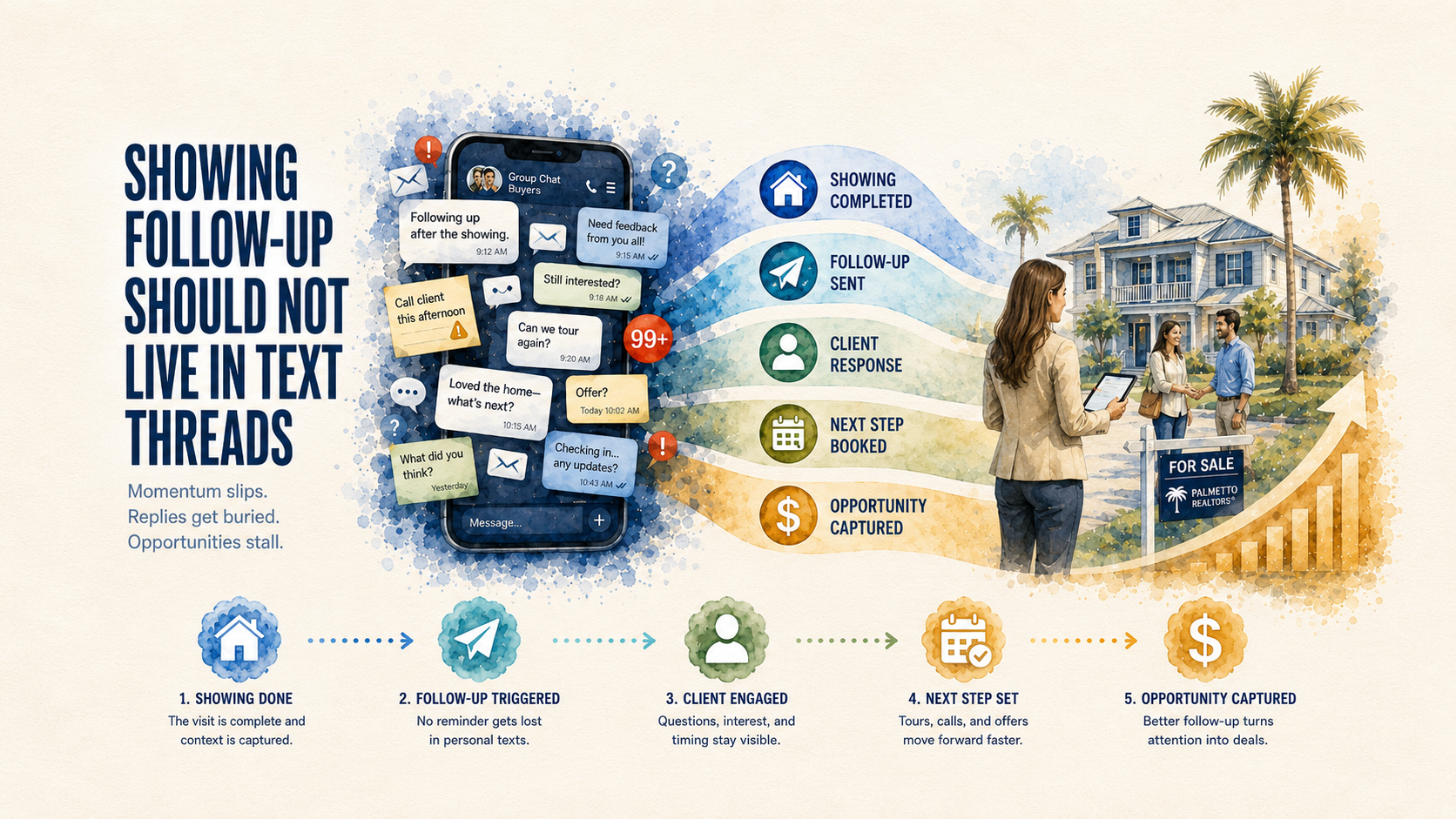
Real estate teams rarely lose momentum because nobody worked hard. They lose it because follow-up after a showing is fragmented, delayed, or trapped in private text threads.
An agent shows the property. A buyer says they liked the kitchen but are worried about the roof. The showing agent sends a text to the lead agent. Someone means to update the CRM later. A task gets mentioned in passing. By the time the team circles back, the buyer has looked at three more homes and the original urgency is gone.
This is not a problem with effort. It is a workflow problem. For many brokerages, realtor teams, and transaction-heavy sales offices, showing follow-up is one of the clearest places where small operational gaps turn into missed appointments, weaker offers, slower decisions, and a less consistent client experience.
The Problem
Showing follow-up sounds simple until you look at how it actually happens.
In a busy team, information moves across text messages, voicemail, CRM notes, email, handwritten notes, and quick conversations between agents and admins. The buyer's reaction may be clear in the moment, but the record of that reaction is often incomplete.
Common breakdowns look like this:
- Feedback from the showing never makes it into the CRM
- The lead agent does not see the buyer's questions until much later
- A buyer says they want comps, disclosures, or financing clarification, but nobody owns the next step
- The agent remembers the emotional tone of the conversation but not the specific objections
- The admin or transaction coordinator is pulled in only after momentum is already slipping
- The team cannot tell which active buyers are heating up and which are quietly cooling off
These are not dramatic failures. That is why they persist. Each one feels recoverable on its own. Across dozens of active buyers and multiple agents, though, the pattern becomes expensive.
Why This Gets Expensive
The cost is not only lost deals. It is also slower decision-making, weaker visibility, and uneven service.
First, speed-to-follow-up drops after a showing. In residential sales, that window matters. Buyers are comparing homes, texting family members, talking to lenders, and browsing new listings the same day. If a team waits too long to respond with the next useful action, the conversation loses energy.
Second, the team's view of buyer intent becomes unreliable. A buyer may look casual in the CRM but actually be close to writing, or look active in the CRM while quietly stalling because an objection was never surfaced cleanly. When the real signal sits inside text threads, leadership is managing from partial information.
Third, handoffs get messy. A showing agent may know what the buyer needs next, but the lead agent, ISA, admin, or transaction coordinator may not. That creates duplicate outreach in some cases and silence in others.
Fourth, client experience becomes inconsistent. One buyer gets a thoughtful recap, next-step email, and timely follow-up call. Another gets a delayed text two days later because the right person never saw the notes. From the client's perspective, that feels disorganized even when the team is working hard.
Over time, this affects more than conversion. It also affects review quality, referral potential, and how confident a team feels about its pipeline.
What a Better Workflow Looks Like
A better system does not require agents to stop using their phones or become data-entry clerks. It requires a cleaner path from conversation to shared operational record.
After each showing, the team should be able to capture a few things quickly and consistently:
- Property shown
- Buyer reaction and confidence level
- Specific objections or open questions
- Requested next step
- Follow-up owner
- Follow-up due date
That information should land in one place the team can actually use, usually the CRM plus a task queue that is visible to the lead agent and support staff.
In a better workflow:
- The showing agent submits a short note by voice, form, or text immediately after the showing
- The system converts that note into structured CRM context for review
- Objections like price, condition, layout, HOA concerns, or financing questions are tagged clearly
- A follow-up task is created with an owner and due time
- The lead agent sees which buyers are moving closer to a decision
- Admin support can prepare comps, disclosures, or recap emails without waiting for a long debrief
The main goal is not perfect documentation. The main goal is that no serious buying signal or next step stays trapped in one person's phone.
Where AI Actually Helps
AI is useful here when it reduces clerical friction and helps the team see the signal faster.
Practical examples include:
- Turning a voice memo or rough text into a clean showing summary
- Extracting objections, preferences, and next actions from unstructured notes
- Drafting a buyer follow-up email for agent review
- Suggesting CRM tags like hot buyer, needs comps, financing concern, or wants second showing
- Flagging buyers who have seen multiple properties without a logged next step
- Building a daily team summary of active buyers who need immediate follow-up
For example, an agent might leave a quick note that says, "They liked the house overall, loved the backyard, worried about the roof age, want to compare it to the place on Oak, and asked for estimated monthly payment with today's rates."
That is useful information, but only if the rest of the team can act on it. AI can turn that messy note into a structured summary, a draft follow-up email, a task for updated financing numbers, and a clear record inside the CRM. We turn 4 hours of work into 4 minutes when the system handles the cleanup and routing instead of asking agents to retype everything later.
The point is not to let AI run the client relationship. The point is to keep good information from getting lost between the showing and the next decision.
Where Humans Should Stay Involved
This workflow still needs humans at every high-trust point.
Agents should stay responsible for:
- Interpreting nuance in buyer motivation
- Advising on pricing, offer strategy, and negotiation
- Handling emotionally sensitive conversations
- Deciding when to push, pause, or reframe the search
- Reviewing outbound follow-up before it goes to a client when the situation is important
Admins and transaction coordinators should stay involved when the next step requires document collection, vendor coordination, scheduling, or compliance-sensitive handling.
Automation should support those people, not replace them. The right system makes the team more organized and more responsive while keeping judgment with the humans who know the client.
A Practical Starting Point
The best first project is usually not "automate the whole CRM." It is narrower than that.
A practical starting point for a brokerage or realtor team is a post-showing capture and follow-up workflow for active buyers.
That project might include:
- A simple mobile form or voice-note intake for agents after each showing
- Automatic creation of a structured CRM note
- A required follow-up owner and due time
- Draft recap emails or texts for human review
- A daily queue of buyers with unresolved objections or missing next steps
- A team dashboard showing which buyers are most likely to move soon
This is a good place to start because the value shows up quickly. The team gets cleaner visibility, faster handoffs, and a more consistent client experience without forcing everyone into a heavy new process.
Once that works, the office can extend the same pattern into open house follow-up, website lead triage, listing appointment follow-up, and transaction milestone reminders.
Final Thought
Real estate teams do not usually have a lead problem. They often have a workflow problem that makes real interest harder to track and act on.
When showing follow-up lives in text threads, important context gets buried, handoffs get delayed, and buyers receive uneven attention at the exact moment momentum matters most.
If your brokerage or realtor team is spending too much time reconstructing conversations, chasing next steps, or guessing which buyers are really moving, Palmetto Intelligence can help turn that into a cleaner, faster, more reliable system.