
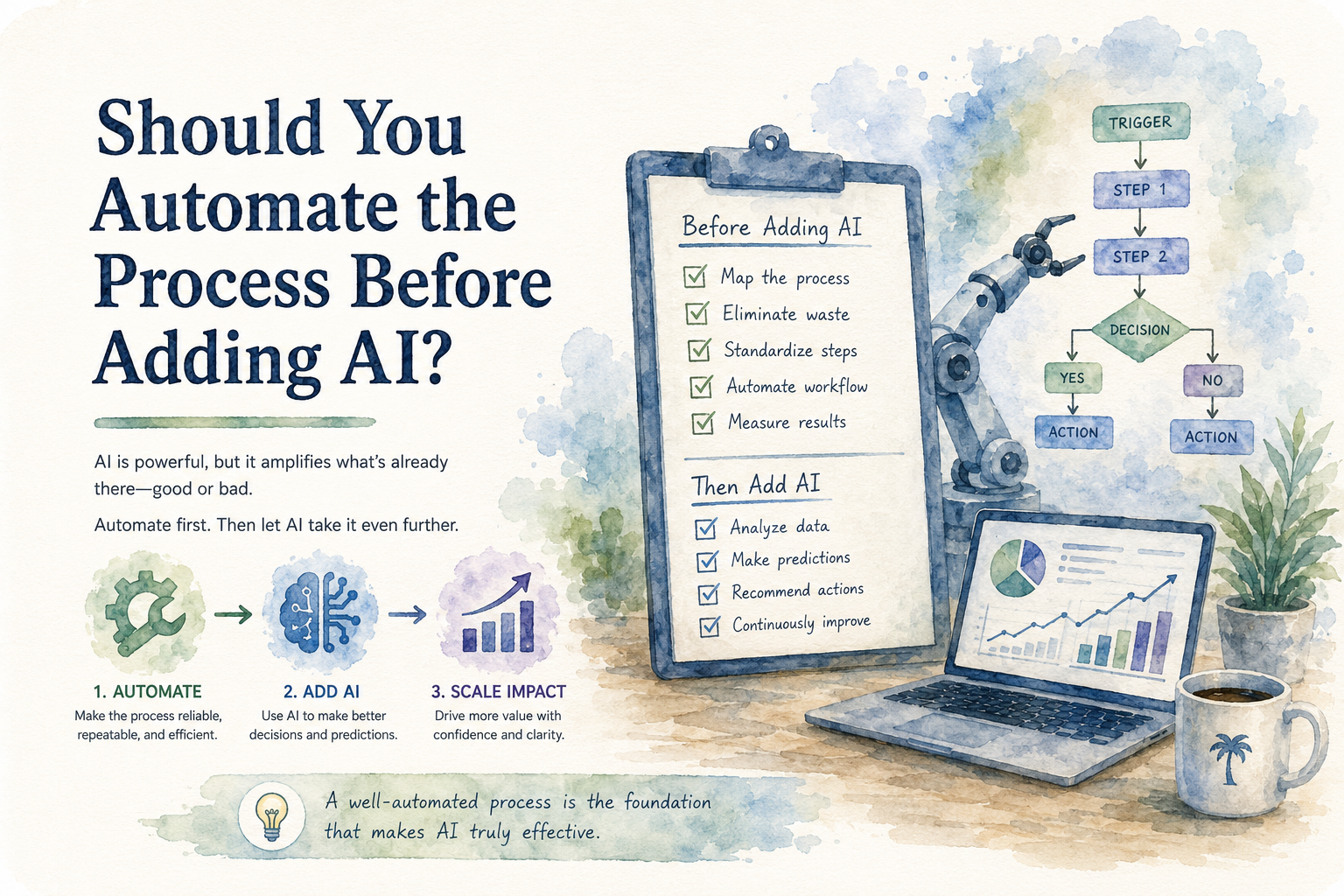
Usually, yes. A business should make the predictable parts of a process reliable before asking AI to handle the parts that require interpretation.
This order matters because AI can make an unclear workflow look more capable without making it more dependable. A polished summary still goes to the wrong person when ownership is vague. A well-written customer update still creates trouble when the underlying status is wrong. The model may perform its assignment exactly as designed while the business process around it remains confused.
The useful question is where fixed rules stop working. That boundary tells you where conventional automation belongs and where AI may earn a role.
Rules Make a Workflow Reliable
Many tasks described as AI opportunities are ordinary automation problems. A completed form can create a CRM record through fixed field mappings, while a closed service ticket can notify the person responsible for billing through a status rule. Each action follows a known event and produces an expected result.
Fixed rules handle this work well because their behavior can be explained in advance. When a required field is empty, the workflow can stop and ask for it. When a dollar amount exceeds an approval limit, the item can move to a manager. The same input should produce the same action every time.
That consistency is valuable. It gives the business a stable path for normal work and makes failures easier to diagnose. If a record never reaches the CRM, someone can inspect the form submission and the integration. The investigation has a defined beginning and end.
AI adds uncertainty by design. It interprets language and produces a probable answer. That ability is useful when the input varies, but it is unnecessary overhead when a simple rule can make the decision.
Give AI the Work That Resists Fixed Rules
AI becomes useful when the business receives information that cannot be handled by a short set of exact conditions. Customers may describe the same service problem in several ways, and even a useful technician note may ignore the office's preferred wording. The meaning remains available to a reader while fixed field mappings struggle with the variation.
Consider a contractor that receives estimate requests through a website form and ordinary email. The website form already has structured fields, so conventional automation can validate the phone number and create the lead. Email is messier. The request may include a forwarded conversation or a photo, and the customer may describe the desired work inside a long paragraph.
AI can read that message and prepare a structured intake record. It can identify the likely service request, summarize the customer's description, and flag missing information. The surrounding workflow should still use rules to decide where the record goes and whether a person must review it.
This division gives the model a narrow interpretive job. The automation remains responsible for movement and control.
One Process Can Use Both
The strongest systems often combine several kinds of work. An estimate request might move through this sequence:
- A fixed trigger captures the form or email.
- AI extracts useful details from unstructured text.
- Validation rules check required fields and known service areas.
- A person reviews an uncertain classification or unusual request.
- Conventional automation creates the record and confirms the handoff.
The sequence keeps each decision with the method best suited to it: rules provide repeatability, AI handles variation, and people resolve exceptions with business consequences.
The same architecture also makes improvement easier. A new service area changes the routing table. Unfamiliar customer language may require better extraction instructions, while a classification carrying financial or safety risk may require human review. The business can improve one layer without rebuilding the whole process.
Design the Boundary Before the Prompt
Teams often begin an AI project by refining prompts, although the more durable starting point is a plain description of the work. Write down what begins the process and what result proves completion, then identify the information and fixed decisions required between those points.
Then mark the points where a capable employee has to interpret language or weigh context. Those are candidates for AI. Mark the decisions where an incorrect answer could commit money or damage a customer relationship. Those deserve a human checkpoint or a narrower scope.
The underlying technology needs attention as well. An automation built on shared passwords and unreliable exports will inherit those weaknesses. The workflow needs stable accounts and controlled access. It also needs dependable source data under a named system owner.
Testing should follow the same boundary. Rules can be checked against known inputs and exact expected results, while AI needs representative examples that include incomplete messages and ambiguous wording. The combined workflow also needs an end-to-end test proving that an exception reaches the right person with enough context to act.
This design makes failure easier to understand. A routing error points toward a rule or source field. A weak interpretation points toward the AI instructions or the examples used for testing. The person responsible for support can investigate a defined layer instead of treating every bad result as an unexplained AI problem.
Palmetto Intelligence helps businesses separate repeatable rules from judgment-heavy work before selecting automation tools. That design step keeps the project focused on the operating result rather than the novelty of the model.
A process becomes a good AI candidate when the business can explain its normal path and recognize its exceptions. The rules establish control. AI earns its place where interpretation genuinely improves the work.