
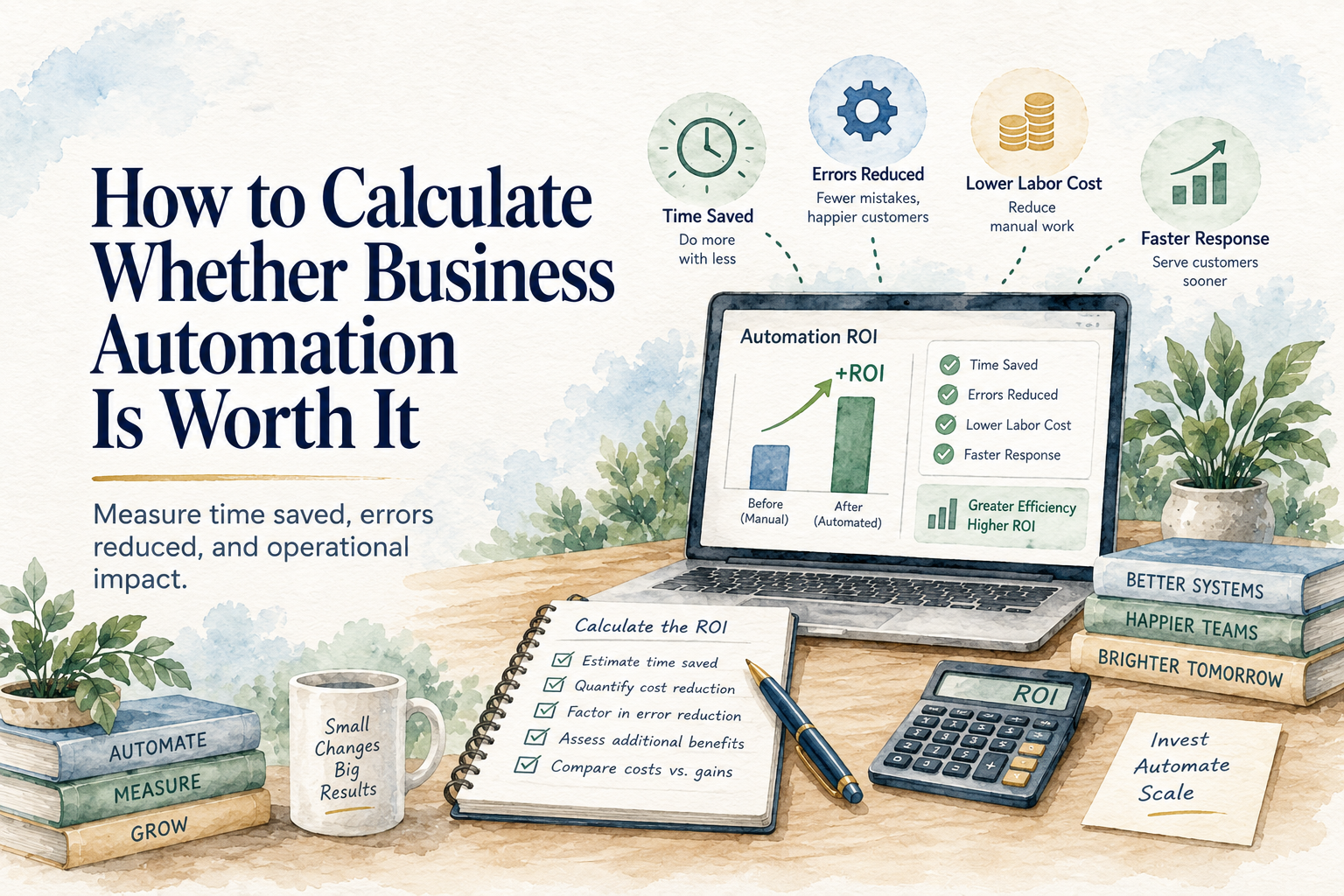
The hardest part of calculating automation ROI is deciding what counts as value. Labor minutes are easy to price, which is why they dominate most estimates. The harder questions involve delays, errors, and the supervision the automation will still require after launch. Those harder questions often decide whether the investment pays.
Suppose a service company receives 40 requests for quotes each month. Each request must be read and converted into a CRM record before the estimator hears about it, a process that takes about eight minutes.
At an assumed labor cost of $30 an hour, removing all eight minutes would save roughly $160 a month. That figure is clean and conservative, yet probably incomplete because hours may pass before anyone notices the request in the inbox. Some records may return because the address or scope is missing. Finding an attachment that never reached the CRM takes more of the estimator's time. Whether the investment works depends on which of those problems the automation actually solves.
Time Saved Is Only Valuable When the Business Can Use It
An automation could prepare the CRM record directly from the inbox while setting incomplete requests aside for review. A person would still approve the record before it reaches the estimator. The company has reduced typing, but it has also shortened the distance between an incoming request and the first meaningful response.
That distinction matters. Five hours of monthly data entry is worth about $1,920 a year under the assumptions above. The company receives that value only if the released time goes somewhere useful. Perhaps the employee can clear a backlog, quote more work, or absorb growing volume without adding another administrative position. If the five hours simply disappear into a day that was never full, the accounting savings exist mostly on paper.
Faster response may be more valuable than the labor reduction, but it is also harder to prove. A company can usually measure how long data entry takes. It may have weak records connecting response time to won work. Giving every faster reply credit for future revenue would turn a cautious estimate into a sales argument.
The honest calculation should therefore separate what is known from what is plausible. Existing payroll and transaction volume can support the labor estimate, while inbox timestamps can reveal the delay. Additional revenue remains a hypothesis until the trial produces evidence.
This is where many ROI estimates go wrong in opposite directions. A labor-only calculation can dismiss an automation that would prevent valuable work from sitting unseen. An optimistic revenue calculation can make almost any project look attractive. Both approaches avoid the uncertainty instead of measuring it.
The Automation Brings Work of Its Own
The same RFQ workflow needs access to the inbox and CRM. Someone has to define which messages qualify, decide what information belongs in each field, and test what happens when the request is incomplete. Early records require close review because a technically successful transfer can still create a bad job record.
That work belongs in the investment. So do the software charges and the time spent reviewing exceptions after launch. Operating cost can rise when credentials expire, a source form changes, or a new service category no longer fits the original rules. The automation has an operating cost even when it runs quietly most of the time.
AI adds another uncertainty. It can interpret a loosely written request better than a fixed field mapping, yet a plausible interpretation can still be wrong. If a reviewer rewrites most of the prepared records, the system has moved the typing rather than removed it. The review burden should appear in the estimate at the rate observed during testing.
Failure costs need the same restraint because the consequence depends on the mistake. A missing internal category may require a quick correction, while a request routed to the wrong estimator can delay a response. The estimate should use known incidents or a defensible range instead of assigning dramatic values to every possible mistake.
Assume, for illustration, that the RFQ workflow costs $6,000 to design and launch, followed by $250 a month to keep it running. First-year cost reaches $9,000, while the labor estimate covers less than a quarter of it. Recovering the difference depends on usable capacity, faster response, or avoided failures.
The gap identifies what the business must learn before approving the full investment.
Let a Trial Resolve the Important Uncertainty
A short trial should preserve the current process long enough to compare it with the proposed one. For the RFQ workflow, the important evidence is the elapsed time before a complete record reaches the estimator. The company also needs to know how often employees correct the prepared record and how much attention the system requires when something changes.
The trial may show that the original labor estimate was too generous. Eight minutes of typing could become four minutes of review, leaving only four minutes of released capacity. It may also reveal that requests reach the estimator several hours earlier and arrive with the original attachments in one place. Both findings belong in the decision.
Volume matters as well. A workflow that handles 40 requests a month has less room to recover a large build cost than one handling 400. The lower-volume company may still proceed when a missed request carries enough consequence, but that judgment should be explicit. It should not hide inside an inflated hourly-savings estimate.
After the trial, the owner can replace assumptions with observed figures. The calculation should include the capacity the company can genuinely use, the delays or failures it can reasonably avoid, and the full cost of keeping the system dependable. Any claimed revenue improvement should have evidence from the trial or remain outside the base case.
Automation deserves funding when it improves the economics of ordinary work under conservative assumptions. If the case assumes flawless output and negligible maintenance, or relies on revenue no one can trace, the business is still looking at a proposal. A measured trial is how it earns the right to become an investment.
The Short Version
Before funding an automation project, answer five questions:
- How much employee capacity will it release, and what will the business do with that time?
- Which delays or mistakes should it prevent, and what do those problems currently cost?
- What will the system cost to build, review, maintain, and support?
- How much human attention will it still require after launch?
- Which benefits can current records support, and which ones need a trial to prove them?
The project is worth pursuing when conservative answers still produce a return. Treat faster response or new revenue as upside until the trial provides evidence.