
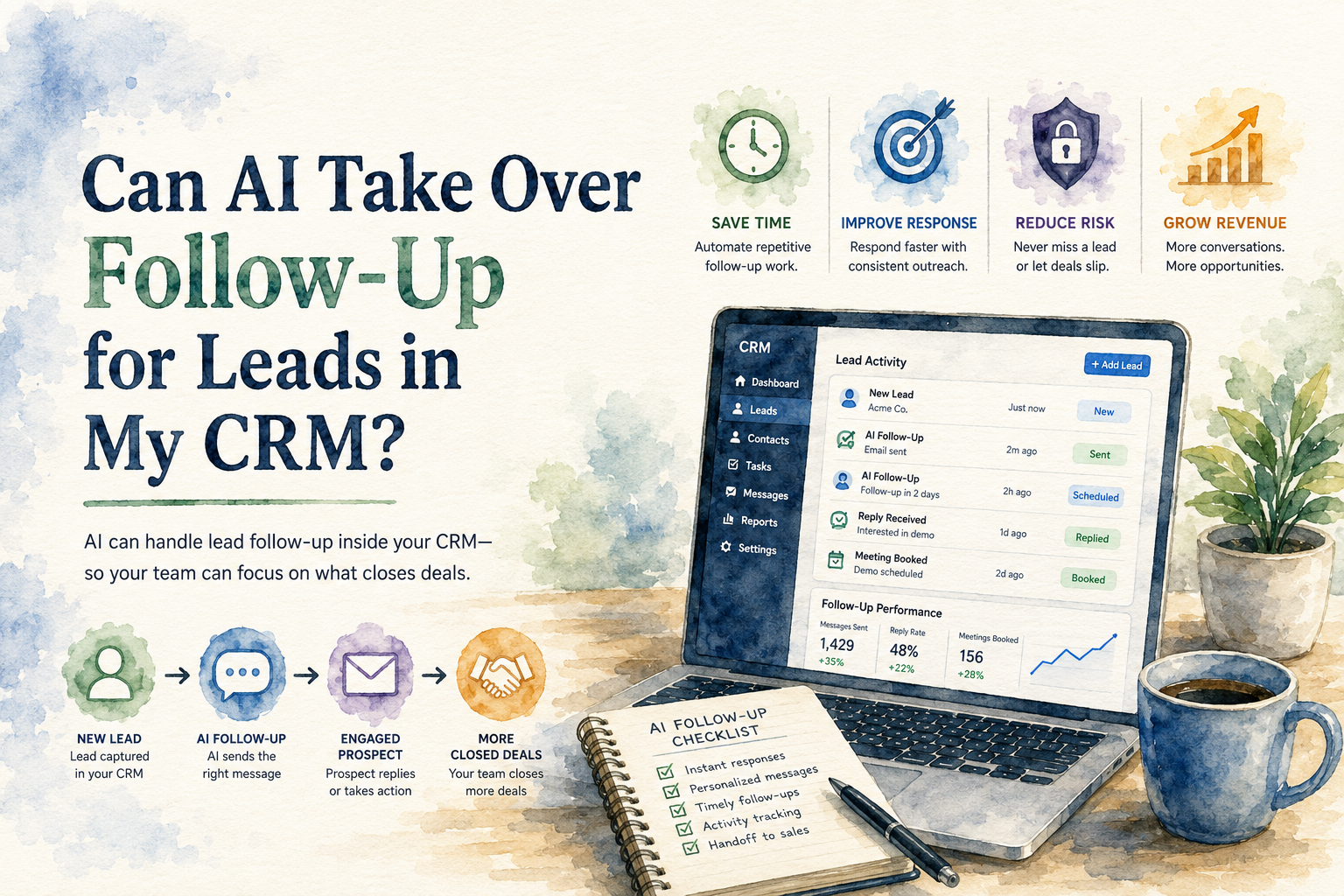
Yes, AI can take over lead follow-up inside your CRM.
Not just remind a salesperson to send a message. Not just draft an email that someone still has to copy, edit, and log. A properly built AI follow-up system can read CRM history, communicate by email, text, or phone, update the CRM after each interaction, and escalate the rare situations that need a real person.
The best version requires proper setup. The AI needs access to the right data at the right time. It needs to know your sales process, your communication style, your escalation rules, and the boundaries around what it should never decide on its own.
Why Manual Follow-Up Breaks
Most businesses lose leads because follow-up depends on people remembering the right thing at the right time. A website form comes in after hours. A referral partner sends an introduction while the owner is on a jobsite. A prospect replies to an old quote with, "Can we still do this next week?" A salesperson plans to answer after a meeting, but then the day moves on with the lead left hanging because they forgot to get to it.
The CRM may contain the lead, but that does not mean the lead is being worked.
In real sales operations, follow-up tends to break in ordinary ways:
- New inbound leads wait too long for the first response.
- Old quotes do not receive consistent check-ins.
- Replies, texts, and calls happen outside the CRM record.
- Leads that need a manager, estimator, owner, attorney, loan officer, or care coordinator sit beside routine prospects.
None of this means the team is careless. It means the workflow depends on memory and individual discipline. That becomes fragile as lead flow increases and communication spreads across email, text, phone, forms, calendars, and CRM tasks.
What Full AI Follow-Up Actually Means
Full AI follow-up does not mean the system sends a generic drip sequence forever.
It means the AI acts from the same operating context a good sales coordinator would use. It knows who the lead is, what has already happened, what the next step should be, and when a human needs to step in.
For example, an HVAC lead may have requested a replacement estimate. The AI should know whether the estimate has been sent, whether financing was discussed, and whether the homeowner asked about install timing. A useful follow-up is not "just checking in." It might be:
Hi Maria, Dustin from Coastal Air here. We sent over the replacement estimate for the upstairs system on Thursday. The 16 SEER option is still available for next-week install if you want us to hold that slot. Do you want James to call this afternoon and walk through the two options?
That message depends on context: the customer's name, the specific job, the prior estimate, the timing, and the company's normal tone.
The same idea works in other sales processes. A real estate team can follow up after a showing based on the buyer's actual objection. A B2B service firm can follow up after a discovery call by naming the workflow problem discussed and the proposed assessment step. A home care agency can follow up after intake while routing sensitive care-plan questions to a qualified person.
The AI can own the routine follow-up, but it needs to operate from the real process, not from a loose prompt.
The CRM Has to Become Context
The CRM is where the system should learn what is safe and useful to say.
At a minimum, the AI follow-up layer should be able to read lead source, owner, stage, prior activities, notes, email history, call outcomes, quoted service, timing, objections, and the custom fields that drive the sales process.
It also needs to understand negative context. If a lead asked not to be contacted by text, the system should respect that. If an email bounced, it should not keep sending to the same address. If a prospect postponed the project until fall, the next follow-up should acknowledge that timing.
This is where simple automations fall short. They can trigger when a field changes, but they do not necessarily understand whether a lead is waiting on a quote, financing, spouse approval, site photos, a discount decision, or a manager review.
A better system treats the CRM as live operating context. Before sending, it should know what the lead is trying to solve, what has already been promised, what communication has already happened, what the next step is, and what would make the conversation unsafe for automation.
The AI Should Write Back to the CRM
If AI communicates with leads but does not update the CRM, it creates a new problem. The conversation moves forward, but the system of record falls behind.
A real AI follow-up system should log activities, update stages when rules allow it, record message outcomes, create tasks, preserve summaries, and flag exceptions. After an email or text reply, the CRM should show what the prospect said and what the system did next.
For example, if a commercial cleaning prospect replies, "We already have a vendor but are unhappy with restroom complaints at two buildings," the system might log the reply, update the lead to active conversation, create a call task, tag the opportunity as a multi-site quality issue, and escalate to a sales manager if the account appears large.
That is different from a chatbot answering a message and disappearing. The CRM remains the source of truth, and management can still see which leads need attention.
Email, Text, and Phone Need Different Rules
AI follow-up can work across email, text messages, and phone calls, but each channel needs its own boundaries.
Email is usually the easiest starting point. It supports longer context, links, attachments, and thoughtful wording. The system can send first responses, quote follow-ups, reactivation messages, missing-information requests, and post-call summaries.
Text is powerful because it gets attention quickly, but it needs consent rules, quiet hours, opt-out handling, and a shorter communication style. A text after a missed appointment should be direct:
Hi Chris, this is Palmetto Roofing. We missed you for the inspection today at 2:00. Do you want to reschedule for tomorrow morning or Friday afternoon?
Phone calls can also be automated in some workflows. AI voice agents can qualify simple inbound leads, confirm appointments, collect missing information, and route callers. But phone automation needs conservative design. The system should identify itself appropriately and transfer quickly when the call moves beyond routine qualification.
The channel strategy should match the sales process. A high-value B2B lead may deserve an immediate email plus a human call task. A missed residential estimate may need a text and a call attempt.
The System Has to Know Your Sales Process
The best AI follow-up systems are built around stages, decisions, and handoffs, not just messages.
A lead follow-up process might include new lead intake, qualification, assignment, first response, appointment booking, proposal follow-up, human review, and then closed won, closed lost, nurture, or disqualified.
Each stage has different communication needs. A new inbound lead needs speed and clarity. A post-estimate lead needs specificity about the quote. A stalled opportunity needs a respectful next step. A lead with a complaint needs a human.
The AI also needs to use the company's communication style. Some businesses are warm and conversational. Some are concise and operational. Some sell to homeowners. Some sell to CFOs, property managers, contractors, or referral partners.
Good setup includes sample messages, stage definitions, sales rules, escalation criteria, forbidden claims, and preferred language. The AI should execute the process the business actually wants.
Exceptions Are the Point
People often imagine AI follow-up as an all-or-nothing decision. The better model is routine automation with clear escalation.
Most follow-up is ordinary: booking links, quote check-ins, availability questions, missing information, and polite reactivation messages. Those are good candidates for automation.
Exceptions should move to the right person quickly. The system should escalate when a lead is angry, asks for a discount outside policy, raises a legal or medical issue, appears high-value, requests a custom proposal, or gives an unclear answer that could be misread.
Escalation should create a clean handoff. Who owns the next action? Why was it escalated? What did the lead say? What has already been sent? When is the response due?
For example, if a mortgage borrower says they were quoted the wrong rate, the system should not try to resolve that. It should log the message, notify the loan officer, create a same-day task, and pause automated follow-up until the human resolves the issue.
That is how automation stays useful without becoming reckless.
A Practical Starting Point
The best first version usually does not need to take over every lead in every stage.
Start with one follow-up lane where the process is clear and the risk is manageable. Good starting points include new inbound lead first response, quote follow-up, appointment confirmation, missing-information collection, dormant lead reactivation, or post-call recap.
From there, define the inputs, outputs, and boundaries. What data does the AI need before sending? Which CRM fields can it update? Which messages require approval? Which situations require a human?
Then test against real records: messy notes, old activities, vague replies, partial data, and edge cases. That is where the system gets useful.
Once the first lane works, expand into text follow-up, call summaries, escalation dashboards, nurture rules, calendars, quoting tools, inboxes, and phone systems.
The end state can be a system that handles most lead follow-up without a salesperson touching every message. But the path there should be deliberate.
Final Thought
AI can take over lead follow-up in your CRM. The stronger version does not merely write messages. It reads the CRM, understands the sales process, communicates through the right channel, writes the outcome back to the record, and escalates the few conversations that need a real person.
That is the difference between AI as a writing assistant and AI as part of the sales operation.
If your team is spending hours every week chasing leads, updating records, sending reminders, and trying to remember who needs the next touch, Palmetto Intelligence can help turn that into a cleaner, faster, more reliable follow-up system.