
The K-Shaped AI Business Environment Is Already Forming
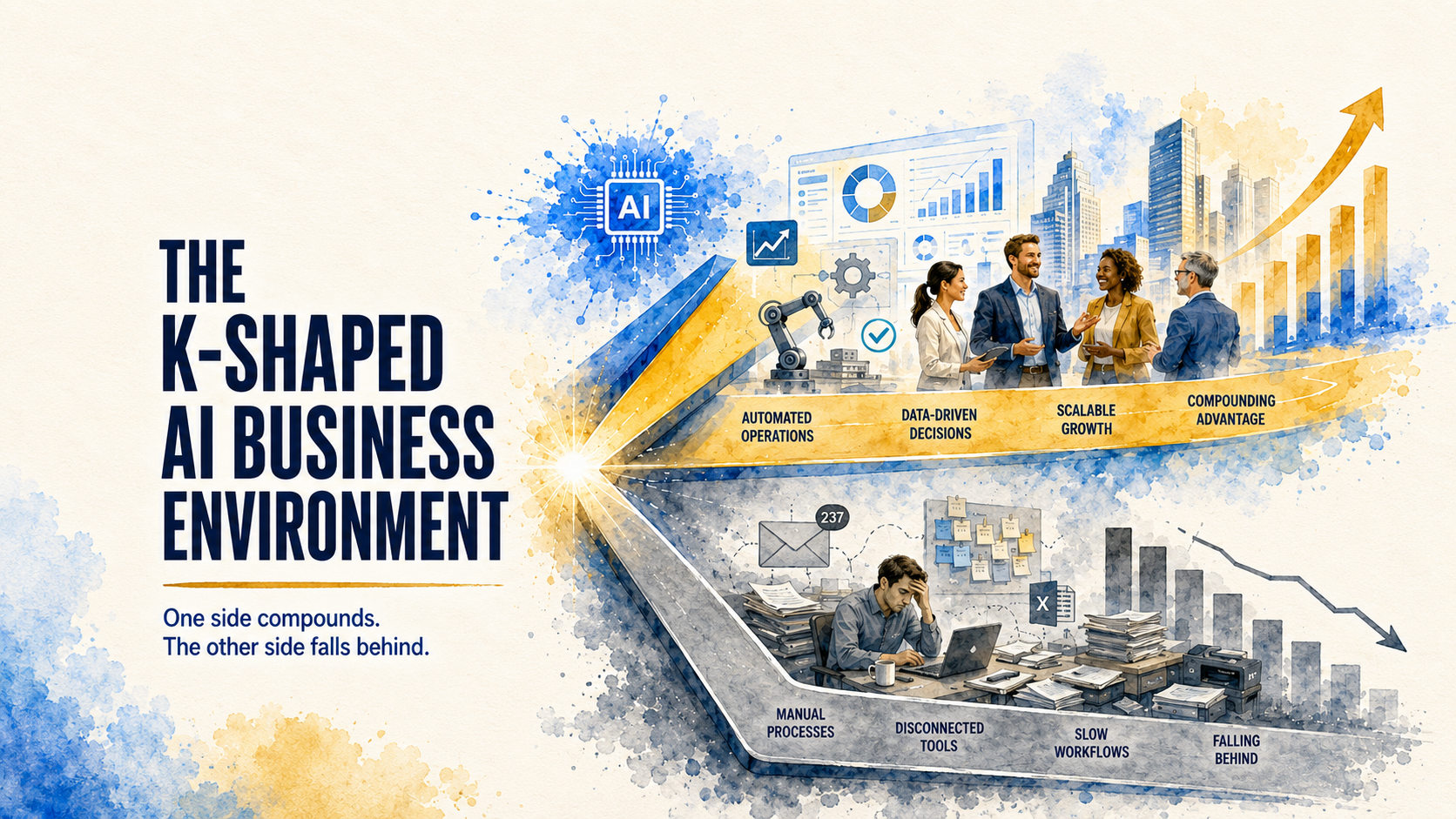
Business competition is starting to split in a way that looks increasingly K-shaped.
On one side are companies whose leaders are actively redesigning the business for the AI age. They are not just experimenting with a chatbot or asking employees to "use AI more." They are looking at how work moves through the company, where decisions get made, where information gets lost, and where intelligent systems can create real operating leverage.
On the other side are companies that still treat AI as optional, experimental, or irrelevant to their industry. Many of those businesses may still look healthy today. They may have loyal customers, experienced people, and decent margins. But over the next few years, the gap between these two groups is likely to widen.
The companies that build useful AI systems into their operations will be able to move faster, handle more volume, respond with better context, and reduce the manual work embedded inside everyday processes. The companies that do not will feel pressure from every direction: higher labor costs, slower response times, thinner margins, more administrative drag, and competitors that can deliver better service with more leverage.
The Problem
Most leaders still underestimate what well-designed AI systems can do.
That is understandable. Many people's first experience with AI is a public chatbot that produces an impressive answer one moment and a questionable answer the next. If that is the mental model, AI looks useful but risky. It feels like a writing assistant, research shortcut, or novelty layer that may help around the edges but should not be trusted with real operations.
That mental model is too limited.
Business AI does not have to mean a person pasting prompts into a chat window and hoping for the best. A serious system can be grounded in company data, constrained by business rules, connected to existing tools, checked against validation logic, routed through approval steps, and designed to handle exceptions carefully.
That changes the conversation.
The question is not whether a model can produce a perfect answer in isolation. The question is whether a business can design a workflow where AI reads the right information, uses the right context, follows the right rules, produces a structured output, validates its own work, and escalates the right cases to people.
When the system is designed that way, AI becomes much more than a productivity tool. It becomes an operating layer.
Why This Gets Expensive
The cost of waiting is not always obvious at first.
A company that delays AI adoption may not see an immediate crisis. Work still gets done. Customers still get served. Employees still use the same inboxes, spreadsheets, software tools, meetings, and manual checks they have always used.
But the gap begins to compound.
One company can process inbound requests in minutes while another takes hours. One company can summarize job status, customer history, open issues, and financial exposure automatically while another waits for a manager to ask three people for updates. One company can catch missing information before work stalls while another discovers it after the customer calls. One company can use AI to review hundreds of records for exceptions while another samples a few and hopes nothing important was missed.
Those differences show up in the economics of the business.
AI-forward companies can often reduce the labor required per unit of work. They can shorten cycle times. They can create more consistent follow-up. They can make reporting faster and cleaner. They can give managers better visibility before problems become expensive. They can let skilled employees spend more time on judgment, relationships, and strategy instead of clerical reconstruction.
Companies that do not make this shift may still have good people, but good people operating inside outdated workflows are forced to carry too much coordination burden. They spend time searching, copying, checking, retyping, summarizing, reminding, and reconciling. That work does not disappear just because the business ignores it. It becomes margin compression.
What a Better System Looks Like
A better AI-enabled business does not remove people from every workflow.
It redesigns the workflow so people are used where they are most valuable.
That means routine information handling should be handled by systems whenever the work is frequent, rule-bound, and reviewable. AI can read emails, documents, notes, transcripts, forms, CRM records, invoices, contracts, job updates, customer messages, and historical data. It can classify information, extract key details, draft responses, flag inconsistencies, summarize context, recommend next actions, and prepare structured records.
The best systems do this with controls.
For example, an AI workflow might:
- Pull context from approved sources instead of relying on memory
- Use templates and structured outputs instead of open-ended responses
- Apply business rules before an action is taken
- Check for missing fields, conflicting information, or unusual values
- Compare results against historical patterns or system-of-record data
- Route low-confidence, high-risk, or sensitive cases to a person
- Keep an audit trail of inputs, outputs, approvals, and changes
This is how hallucination risk is reduced in real business use. The system should not simply ask AI to invent an answer. It should ground the answer in known information, constrain the possible output, validate the result, and prevent the system from acting beyond its authority.
No serious operator should pretend errors are impossible. But it is also a mistake to assume AI must be unreliable because a general chatbot sometimes guesses. A well-designed workflow can make AI output far more controlled, useful, and auditable than most leaders realize.
Where AI Actually Helps
AI creates leverage when it gives the business more context, speed, and consistency than a manual process can provide.
That applies across far more industries than many leaders expect.
In a home service company, AI can review estimate activity, customer replies, technician notes, and job status to surface stalled revenue. In a real estate office, it can turn showing notes and buyer messages into structured follow-up. In a manufacturing business, it can monitor order changes, supplier messages, production exceptions, and customer commitments. In finance, it can read invoices, match records, classify transactions, and route exceptions. In a professional services firm, it can summarize client history, project status, open decisions, and next steps before every meeting.
The details vary by industry, but the pattern is similar.
Most businesses have too much useful information trapped in unstructured places: inboxes, PDFs, phone calls, spreadsheets, notes, chat threads, portals, and disconnected software systems. People waste time turning that information into something the business can act on.
AI is unusually good at that middle layer.
It can absorb far more context than a person can reasonably review before every decision. It can look across many records quickly. It can produce a draft, summary, classification, exception list, or recommendation in seconds. It can help a manager see where attention is needed without asking the team to manually prepare the view.
That does not mean AI should own every decision. It means AI can prepare the decision environment better than the old workflow did.
Where Humans Should Stay Involved
The strongest AI systems are not the ones that pretend people are unnecessary.
They are the ones that know exactly where people matter most.
Humans should stay close to workflows where nuance is high, trust is important, relationships matter, strategy is involved, or the cost of a wrong decision is significant. That includes negotiation, sensitive customer communication, hiring decisions, leadership judgment, pricing tradeoffs, conflict resolution, complex approvals, reputation-sensitive messages, and decisions that depend on context not fully captured in the system.
This is one of the biggest operating-model changes of the AI age.
Two or three years ago, many businesses still had to use people as the connective tissue between systems because the technology could not reliably interpret messy business information. People had to read the email, understand the attachment, update the spreadsheet, summarize the call, check the policy, draft the reply, and remember the next step.
That is no longer the right default.
The better default is to let systems handle the repeatable information work and use people for judgment, relationship-building, and strategic thinking. That changes staffing, management, training, reporting, and process design. It also changes what good leadership looks like.
Leaders now need to understand where the business creates value, where work is being slowed by outdated coordination patterns, and where AI can safely create leverage without weakening trust or control.
A Practical Starting Point
The right starting point is not "use AI everywhere."
The right starting point is to identify a workflow where better speed, context, or consistency would matter economically.
Good candidates often have several traits:
- The work happens frequently
- The current process depends on manual reading, checking, or routing
- Information is scattered across multiple systems or communication channels
- Delays create revenue leakage, higher labor cost, or customer frustration
- The workflow has clear rules for normal cases and identifiable exceptions
- A human can review high-risk outputs before anything customer-facing or financially important happens
For many companies, the first project might be estimate follow-up, inbound request triage, invoice processing, customer update drafting, document review, CRM cleanup, reporting automation, or exception monitoring.
The point is to pick a workflow where AI can create visible operational leverage quickly. Once the business sees that pattern working, the next opportunities become easier to identify.
This is where leadership matters. Companies that wait for a perfect off-the-shelf answer may move too slowly. Companies that chase random AI experiments may waste time. The winners will be the ones that connect AI to real operating problems, build controlled systems around it, and keep improving those systems as the technology gets better.
Final Thought
AI will touch every type of business, including many businesses whose leaders currently believe it does not apply to them.
That does not mean every company needs the same tools or the same roadmap. It means every company needs to rethink how work should be structured now that intelligent systems can read, reason over, summarize, classify, draft, validate, and route business information at high speed.
The K-shaped environment is forming because some businesses are making that shift and others are not. The first group will build more leverage into the same team, the same customer base, and the same operating model. The second group will continue carrying manual coordination costs that competitors are learning how to remove.
If your team is spending hours every week chasing information, rebuilding context, checking routine work, or trying to understand what needs attention, Palmetto Intelligence can help turn that into a cleaner, faster, more reliable operating system for the AI age.