
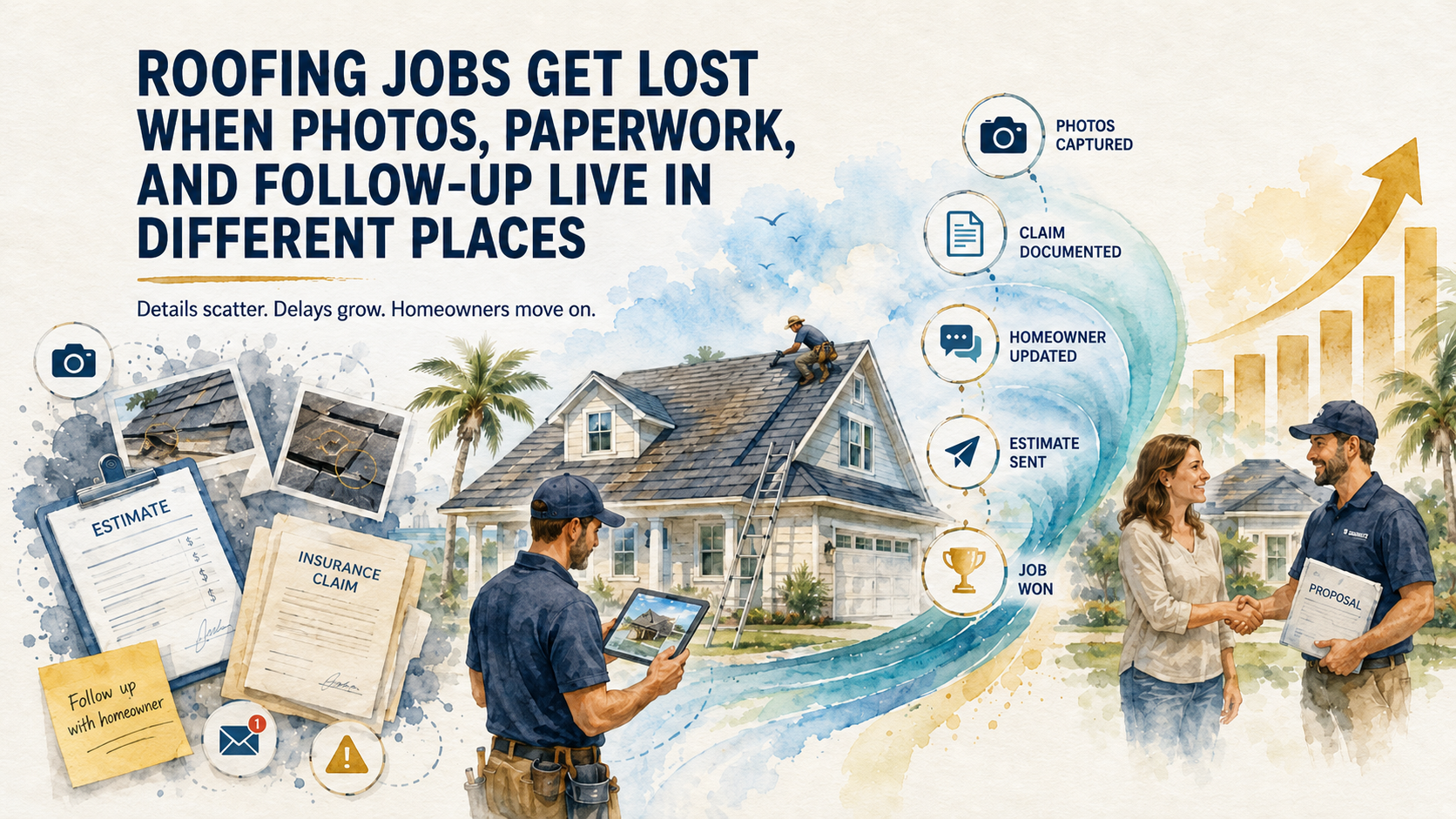
Why Roofing Companies Lose Jobs When Inspection Photos, Insurance Paperwork, and Homeowner Follow-Up Live in Different Places
Roofing companies do not usually lose momentum because they lack demand. They lose it in the space between the inspection, the estimate, the paperwork, and the next customer conversation.
A rep inspects the roof. Photos sit on a phone. Notes get dropped into a CRM later, or not at all. Insurance documents arrive by email. Someone in the office is waiting on measurements, someone else is waiting on supplement details, and the homeowner is waiting for an update. Nothing is technically lost, but the job slows down because the workflow depends on people remembering where everything is and who owes the next step.
For many roofing companies, this is where revenue starts leaking. Not because the team is careless, but because critical handoffs are still manual and scattered.
The Problem
Roofing sales and production involve more moving parts than many owners expect.
Even before a contract is signed, one opportunity can generate photos, inspection notes, estimate revisions, insurance correspondence, measurement reports, financing questions, material decisions, scheduling requests, and homeowner follow-up. After the sale, the coordination expands again: permits, supplements, production timing, crew scheduling, change orders, punch items, and final payment.
Most roofing companies already use some mix of CRM, estimating software, email, texting, cloud storage, and accounting tools. The problem is that the workflow between those tools is still held together by inboxes, memory, and repeated status checks.
Common breakdowns look like this:
- Inspection photos are captured, but not tied cleanly to the job record
- Insurance paperwork arrives, but the sales or office team does not see it quickly
- A supplement is needed, but nobody owns the follow-up sequence
- The homeowner asked a question by text, but the answer never makes it into the shared record
- An estimate was sent, but no one can tell which open jobs are waiting on customer response
- The office has to ask the rep for missing documents before the next step can happen
- Managers cannot see which jobs are stalled because of documentation versus actual customer hesitation
None of these issues look dramatic in isolation. That is why they persist. The team keeps working hard, but the business runs with too many invisible dependencies.
Why This Gets Expensive
This gets expensive because roofing is not only about winning jobs. It is also about keeping them moving.
First, follow-up slows down. If the homeowner is waiting for an updated estimate, an explanation of the insurance process, or confirmation that their documents were received, even a short delay can cool urgency. In competitive situations, that delay can hand the next conversation to another roofer.
Second, office labor increases. When job status is unclear, staff spend time reconstructing it. They search email threads, text chains, shared drives, CRM notes, and rep messages just to answer simple questions: Did we receive the adjuster report? Did anyone send the revised estimate? Are we waiting on the homeowner or on ourselves?
Third, sales leadership loses visibility. A pipeline report may show plenty of open opportunities, but that does not tell you which ones are healthy, which ones are stuck waiting on paperwork, and which ones are drifting because follow-up became inconsistent.
Fourth, customer confidence drops. Homeowners understand roofing projects can involve inspections, insurance steps, and scheduling complexity. What they do not like is silence, contradictory updates, or having to repeat information.
Over time, that creates real cost:
- Slower estimate-to-close cycles
- More admin time per job
- More dropped handoffs between sales and office staff
- More avoidable delays before production can start
- Less reliable forecasting for owners and managers
The issue is not that people are not working. The issue is that the company cannot reliably move each job from one stage to the next without manual chasing.
What a Better Workflow Looks Like
A better roofing workflow does not start by replacing every system. It starts by making the handoffs visible and consistent.
For a typical retail or insurance-influenced roofing opportunity, the company should be able to see a clean sequence:
- Lead received
- Inspection completed
- Photos and notes attached to the job
- Estimate prepared or updated
- Insurance or adjuster documents captured if relevant
- Homeowner questions and objections logged
- Follow-up owner and due date assigned
- Contract or approval status confirmed
- Production handoff completed
The important part is that each stage has a clear next action and a visible owner.
In a better workflow:
- Inspection photos are uploaded and linked automatically to the right opportunity
- Voice notes or rough field notes are turned into a structured summary for review
- Insurance documents coming into a shared inbox are matched to the correct job
- Missing items trigger a task instead of relying on someone to remember
- Homeowner replies are summarized into the shared record so the office and sales team are aligned
- Managers can see which jobs are waiting on the customer, which are waiting on internal documents, and which are ready for the next move
That kind of visibility matters because roofing jobs do not stall for one reason. They stall for many small reasons. A useful workflow makes those reasons obvious early.
Where AI Actually Helps
AI can help in roofing when it reduces clerical drag and speeds up internal clarity. It is most useful when it turns messy inputs into cleaner operational records.
Practical examples include:
- Turning field voice memos into inspection summaries
- Extracting homeowner questions or objections from text and email threads
- Drafting a follow-up email after an inspection or estimate for human review
- Classifying inbound documents such as adjuster reports, approvals, or scope changes
- Flagging open opportunities that have documents attached but no follow-up scheduled
- Creating a daily exception list of jobs stuck on missing paperwork, unanswered questions, or incomplete handoffs
For example, a sales rep might leave a quick note after an inspection: "Older shingle roof, visible storm damage on rear slope, homeowner says adjuster visited yesterday, wants to know next step, spouse needs to review the estimate tonight."
That note should not stay as an unstructured message in one person's phone. AI can turn it into a usable draft summary with damage observed, insurance context, decision-makers involved, an open question, and a recommended next follow-up. A human still reviews it, but the clerical step gets shorter and more consistent.
This is where Palmetto Intelligence's approach tends to fit well. The goal is not to replace your sales team. It is to build a reliable system around the work your team is already doing.
Where Humans Should Stay Involved
Roofing companies should keep humans in control anywhere judgment, trust, or financial commitment matters.
That includes:
- Interpreting the real sales situation with the homeowner
- Explaining scope, pricing, tradeoffs, and timing
- Handling insurance nuance and disputed details
- Approving outbound communication before it is sent in sensitive situations
- Deciding when an opportunity is genuinely cold versus temporarily delayed
- Managing production promises and exception calls
AI should support the team, not improvise on the company's behalf.
That is especially important in home services, where a wrong message can create confusion, overpromise timeline certainty, or weaken trust. The safer pattern is simple: the system organizes, drafts, flags, and routes; the team reviews, decides, and communicates.
A Practical Starting Point
For many roofing companies, a better starting point is one narrow workflow: inspection-to-estimate follow-up.
That can include:
- Capturing inspection notes in a consistent format
- Linking photos and documents to the correct opportunity
- Flagging missing estimate inputs before the job stalls
- Drafting the next homeowner follow-up for review
- Creating a queue of opportunities that have gone quiet after the estimate
If that workflow improves, the business usually gets immediate value in three places: cleaner admin work, faster follow-up, and better visibility into what is actually blocking revenue.
From there, it becomes much easier to extend the system into supplement tracking, production handoffs, final paperwork, or review request workflows.
If your team is spending hours every week chasing documents, checking status, and rewriting the same follow-up messages, Palmetto Intelligence can help turn that into a cleaner, faster, more reliable system.
Final Thought
Roofing companies do not need more noise around AI. They need workflows that work when the real job gets messy.
When inspection photos, insurance paperwork, and homeowner follow-up live in different places, the business becomes slower than it needs to be. Jobs wait, staff chase status, and good opportunities lose momentum for avoidable reasons.
The better opportunity is not to automate everything. It is to make the handoffs dependable, make the exceptions visible, and keep the human team focused on the parts of the job that actually require trust and judgment.