
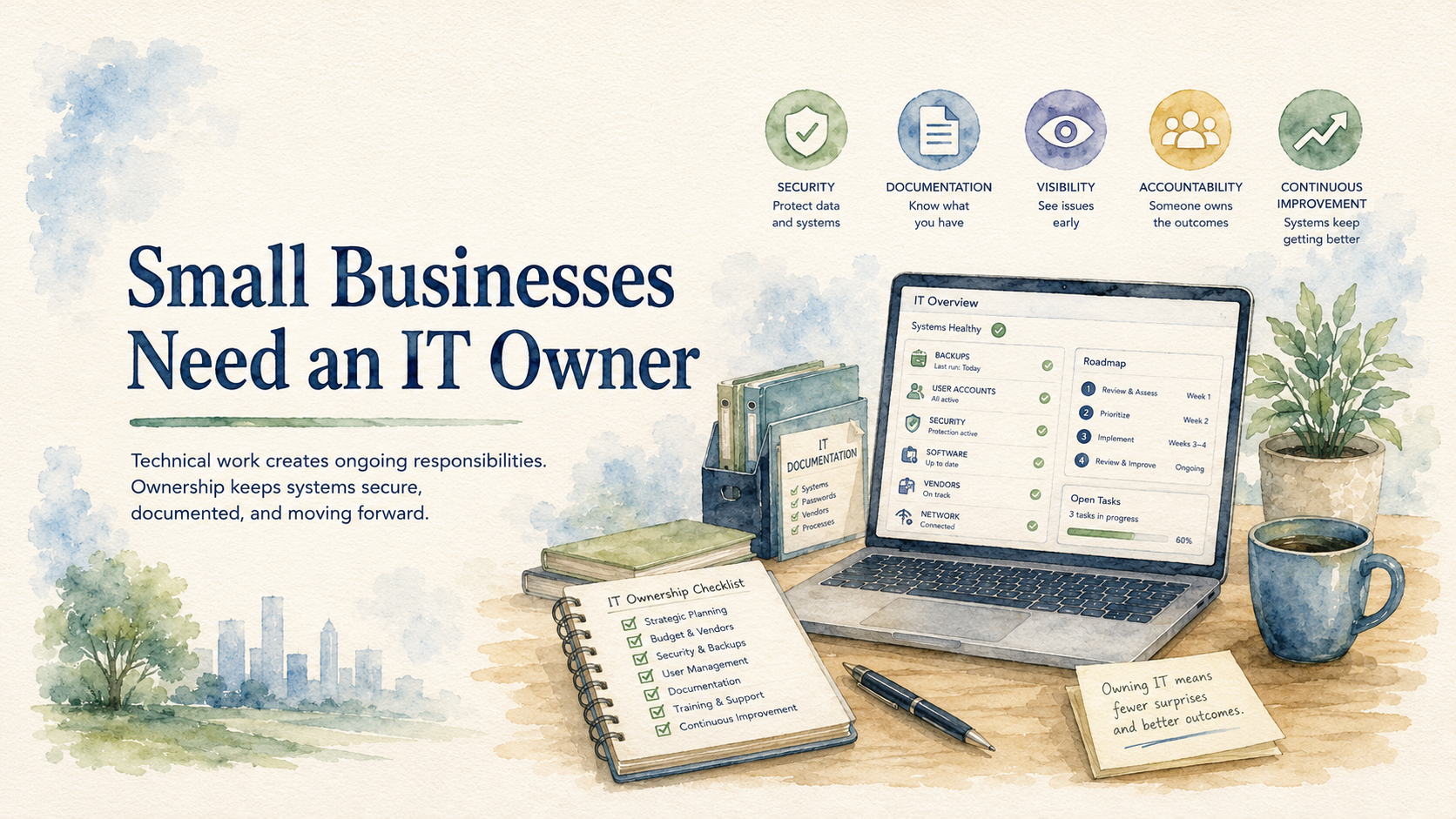
Small businesses need an IT owner because technical work creates responsibilities that remain after an individual task is finished.
Paying for technical support does not solve this by itself. A vendor accepts responsibility for a defined product or incident. The business still owns the consequences of how that product is used, and someone must carry that responsibility on its behalf.
This arrangement can look fine for years because many technical problems stay inside the boundary of a single product or incident. The gap appears when a normal business decision affects technology in more than one place.
Consider an employee leaving the company. Disabling the employee's email account may take only a few minutes, but the account itself is not the whole decision. The business needs to understand what would become inaccessible when that account disappears.
That question cannot be answered by reading a support ticket. It requires context about how the company works. A vendor can explain how to disable an account, but the vendor cannot decide what the business must preserve before doing it.
IT ownership begins where the vendor's instructions end, with responsibility for continuity across those boundaries. The IT owner may solve the problem or bring in a specialist, but responsibility for the outcome does not move.
That does not require knowing every technical answer. In fact, treating technical knowledge and ownership as the same thing causes part of the problem. The person who knows how to restart a router may be useful during an outage without being responsible for the company's network. Being able to complete a task is not the same as owning the result.
When nobody has that responsibility, it usually returns to the business owner by default. The owner becomes the person who has to recover the history of every decision before anyone can fix the current problem. Even good vendors become less useful because each one is working with only the fragment the owner managed to reconstruct.
The cost is easy to underestimate because it does not always appear as a major outage. More often, the company pays through hesitation. Even a routine change slows down while people work out what it might disturb, and recurring problems survive because every occurrence is treated as a separate event.
Small companies are especially vulnerable to this because so much context lives in memory. Informal knowledge feels efficient when the same people have worked together for years. It becomes a liability as soon as the company needs to act without one of them.
This is why the need for ownership has little to do with headcount. A ten-person company may depend on technology just as completely as a company with a hundred employees. The smaller company has fewer people available to notice the gaps and less room for work to stop while somebody reconstructs what happened.
A company of that size may not need a full-time IT department. Palmetto Intelligence can still serve as its IT owner. We learn how the business uses its technology and stay responsible when a problem does not fit neatly inside one vendor's support queue.