
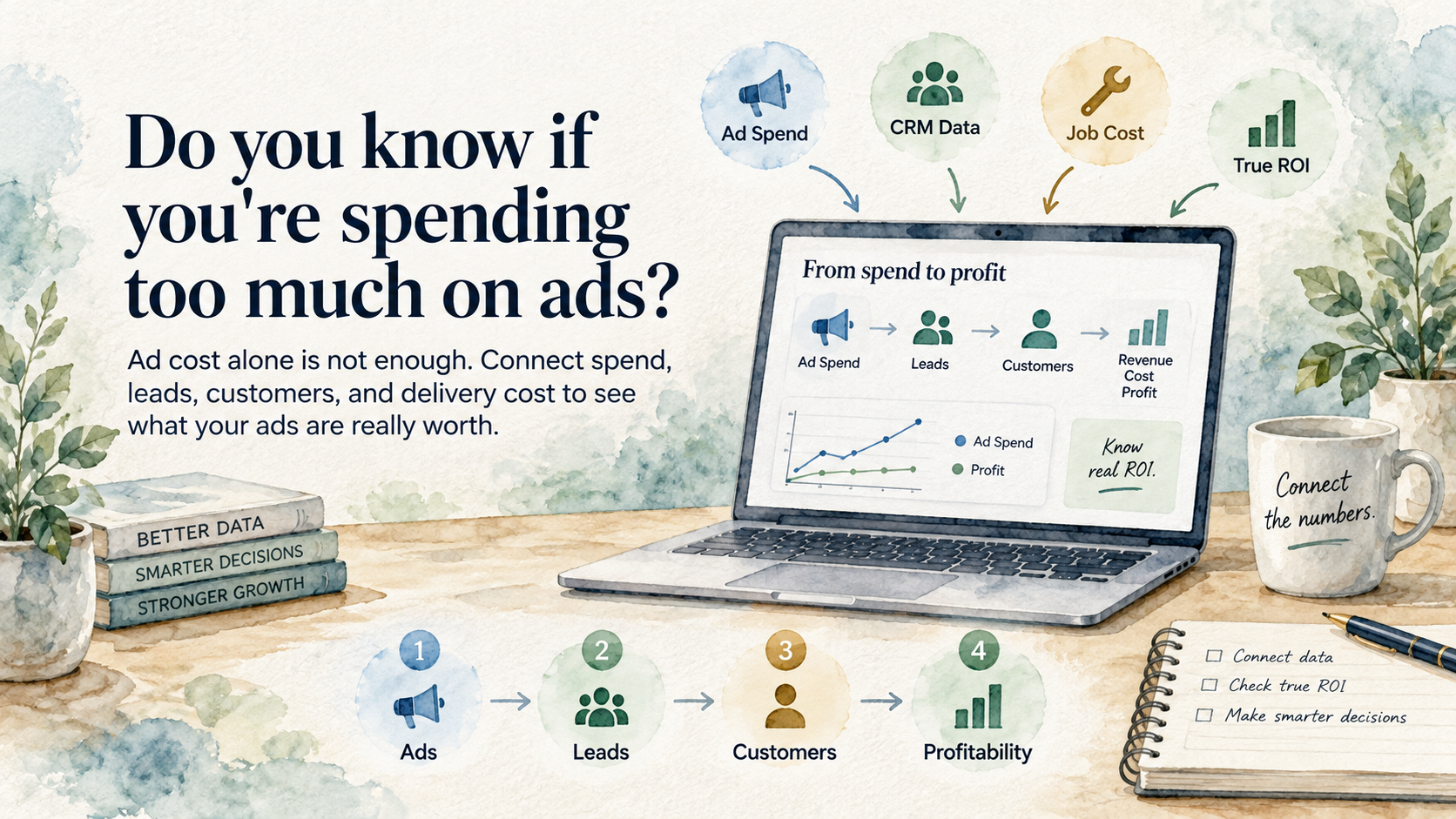
If your ad report stops at clicks and form submissions, you don't know whether you're spending too much. You know what the ads cost. That's it.
A lot of small businesses are making budget decisions with exactly that amount of information. The ad platform has the click and lead counts, the CRM knows which leads became customers, and accounting knows what the work cost to deliver. Those systems often never connect, so the owner ends up comparing this month's ad bill with this month's lead count and hoping the relationship is good enough.
I wouldn't increase or cut a budget based on that report. A cheap lead can be worthless, while an expensive lead can turn into a great customer. Neither fact shows up when the reporting ends at the form.
The missing information is everything that happened after the lead came in.
Follow one campaign all the way through
Suppose a local service business spends $8,000 on ads and gets 80 form submissions. The cost per lead is $100. Sixteen people buy, producing $24,000 in revenue.
The ad platform can report a 3-to-1 return on ad spend. That sounds healthy until the company includes the cost of doing the work.
Say the business keeps $450 from each job after labor, materials, and the other direct costs of delivery. Sixteen jobs produce $7,200 before ad cost. The company spent $8,000 to get that work, so it is already $800 behind. An agency or management fee makes the loss larger.
The campaign brought in revenue. It also lost money.
That distinction is easy to miss because revenue return on ad spend and profit are different calculations. Google's own glossary separates ROAS, which compares conversion value with ad spend, from ROI, which looks at profit relative to the cost. Google also lets advertisers send values such as revenue or profit margin with conversions.
The advertising system can only optimize for the result it receives. Send it form submissions and it will look for more people who fill out forms. Send it completed sales with useful values and it has a chance to look for people who resemble profitable customers.
Getting there takes more than changing a setting in Google Ads. The original source has to stay attached to the lead in the CRM. When that lead becomes a customer, the sale needs to remain connected to the same record. Once the job is complete, revenue and direct cost have to make it back to that customer journey.
Small businesses often have each piece without having the chain. Marketing can trace the source to the form, but sales and operations take over in other systems before accounting sees the final dollars. Each system can be accurate on its own while the business remains unable to answer whether a particular campaign made money.
This blind spot tends to reward the wrong campaign. One campaign may produce plenty of $60 leads that rarely turn into good work. Another may generate $140 leads that close more often and carry better margins. A report built around cost per lead will favor the first campaign, even when the second puts more money in the bank.
Attribution will never be perfect. Someone may see an ad, come back through a search, and call from another phone. A consistent, imperfect connection from source to sale is still far more useful than pretending every form submission has the same value.
What would five percentage points save?
Take a business earning $100,000 in gross profit each month and spending 17% of that amount on advertising. The monthly ad bill is $17,000.
If better tracking lets the company remove weak spend and hold gross profit at $100,000 while bringing ad spend down to 12%, the new bill is $12,000. The difference is $5,000 per month and $60,000 over a year.
That is the answer to how much the business would save. It is also where owners need to be careful. Dropping from 17% to 12% does not help if gross profit falls by $8,000 a month with it. The percentage is useful only when the business can see what happened to profit.
The same logic applies when the right answer is to spend more. If another $2,000 in advertising reliably produces $4,000 in additional profit after the work is delivered, cutting the budget to hit an arbitrary ratio would be a mistake.
Average campaign performance can hide this decision. The first $5,000 may capture the strongest demand while the next $5,000 reaches people who are less likely to buy. I would evaluate the increase on what the added dollars produced. If the extra $2,000 brings back only $1,500 in profit before ad cost, that portion of the budget needs to go.
Capacity belongs in the calculation too. A profitable lead has less value when nobody can answer it quickly or the schedule is already full. More demand can push response times up and service quality down. At that point, the business may be paying to crowd out referrals and repeat customers it could have won at a lower cost.
There isn't one percentage that tells every company what to spend. The useful answer comes from following the money through the whole customer journey, then deciding whether the next part of the budget earns its place. Without that connection, an owner can see every click and still have a large blind spot around profit.