
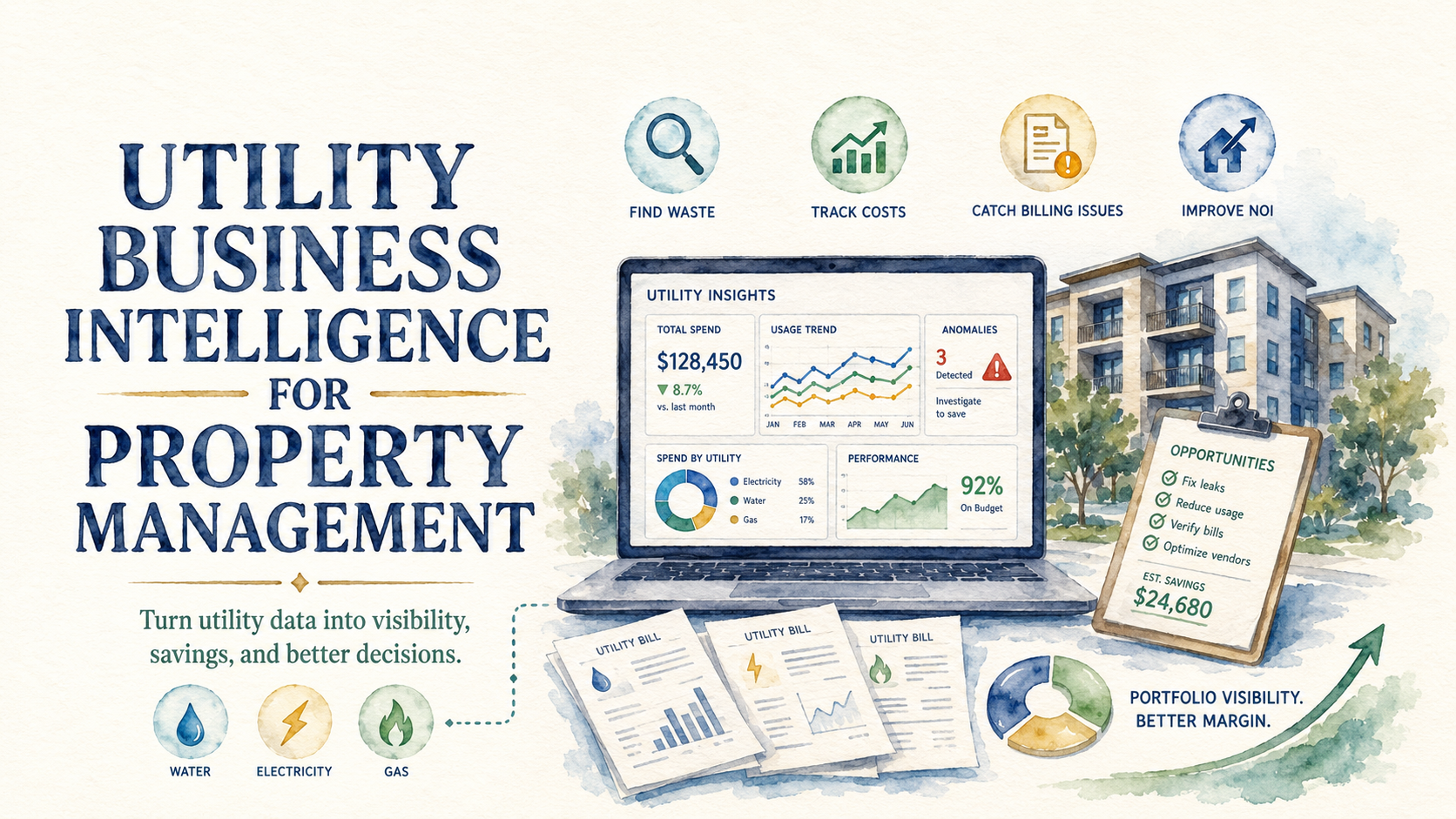
Utility bills are one of the quieter places where property management margin disappears. Rent is visible. Vacancies are visible. Work orders are visible when a resident is upset. Utilities are different. Water, sewer, electric, gas, trash, and common-area usage often move through the business as invoices, reimbursements, owner statements, resident charges, and spreadsheets.
By the time someone asks why a building's water bill doubled, the money may already be gone. A toilet may have been running for weeks. A vacant unit may still have electric usage. A resident may have skipped without transferring service. A property may be priced as "utilities included" even though the actual cost no longer supports that rent.
That is where business intelligence can help. The practical value is a system that collects utility data, normalizes it by property and unit, shows managers where cost is moving, and flags exceptions early enough that someone can act. For a property management company, utility business intelligence answers a basic operating question: are utilities being managed as a known cost, or are they being discovered after the fact?
Why Utility Decisions Are Harder Than They Look
If utilities are included, the unit may be easier to market and the resident gets a simpler monthly payment. The owner may also avoid unpaid municipal water surprises tied to the property. But the manager is taking on usage risk. A leak continues unnoticed. Irrigation runs too often. A common-area meter gets charged to the wrong property. The average cost used to set rent may be based on last year's rates, last year's occupancy, or a period before a utility increase.
If utilities are not included, the business still needs visibility. A resident may fail to transfer service after move-in. A tenant-billed account may become delinquent in a way that still creates owner exposure depending on the utility and local rules. A vacant unit may keep using power because maintenance left equipment running.
This is why a simple "tenant pays" or "owner pays" label is not enough. Managers need to see utility cost by property, unit, meter, owner, lease structure, and time period.
What Utility Business Intelligence Should Track
The first useful version does not need to be exotic. A Power BI report, a database, or a custom reporting portal can go a long way if it tracks property, unit, owner, utility type, vendor, account number, meter number, billing period, usage, total charge, late fees, occupancy status, lease utility responsibility, and whether the bill is included in rent, separately billed, capped, reimbursed, or owner-paid.
The key is joining the bill to the operating facts around it. A $420 water bill may be normal for one property and alarming for another. A high electric bill in July may be expected in a large occupied Florida rental, but strange in a vacant unit.
Setting Rent, Utility Fees, and Caps With Better Data
A better report would show a rolling history by property and unit type: average monthly cost, seasonal highs and lows, cost per occupied day, owner-paid common-area utilities separated from resident-unit utilities, confirmed outlier months, and trend after rate increases.
For example, suppose a duplex has historically averaged $155 per month in water, sewer, and trash when fully occupied. The last few summer months averaged $210 because irrigation was running more often and the city raised rates. One month hit $390 because of a toilet leak that maintenance later repaired.
If the manager uses the most recent bill, the utility fee may be too high. If the manager uses the old annual average, the owner may underprice the lease. A better approach is to show the normal range, remove the confirmed leak month from the pricing baseline, account for the rate increase, and set a fee or rent adjustment with a reasonable buffer.
The same logic applies to caps. If utilities are included up to a monthly cap, the cap should not be copied from a lease template. It should be tied to the property's real cost profile, the local rules, and the owner's risk tolerance. The business intelligence system does not make that legal or leasing decision by itself. It gives the manager the evidence needed to make the decision cleanly.
Finding Leaks Before the Bill Becomes a Fight
Water leaks are one of the clearest examples of why utility reporting matters. A running toilet, irrigation issue, slab leak, water heater problem, or hidden plumbing failure can turn into a large bill before anyone sees visible damage.
The old process is reactive. A bill arrives. Someone notices the amount looks high. Maintenance checks the property. The owner asks why nobody caught it earlier. Then the office decides whether to request a utility adjustment, bill the resident, absorb the cost, or split responsibility.
A better system flags the issue when usage first departs from the property's pattern.
The report can compare current water usage against the unit's prior billing periods, similar units in the same property, and occupancy status. If a single-family rental normally uses 4,000 to 6,000 gallons per month and suddenly reports 18,000 gallons, the system should create an exception.
The exception should be specific:
"Water usage at 214 Palm Street is 2.9x the trailing six-month average. Unit is occupied. No open plumbing work order. Last inspection 74 days ago. Recommended next step: ask resident about running toilets or visible leaks and dispatch maintenance if no explanation is confirmed."
That is useful because it turns a bill into a workflow. The manager knows what changed and what action should happen next.
Catching Skips and Vacancy Problems Earlier
Utilities can also provide an early signal that a resident has left, is preparing to leave, or has stopped following normal lease obligations.
No single utility pattern proves a skip. People travel and usage changes. But when utility data is connected to rent payment, maintenance access, communication history, and occupancy records, it can become part of an early warning system.
Consider a resident who is behind on rent, has stopped responding, and suddenly shows near-zero electric usage in a unit that was previously occupied. Or a property where the tenant was supposed to keep utilities active, but service confirmation is missing after move-in. The point is not to let software accuse anyone of anything. The point is to help the property manager prioritize a check before the situation becomes more expensive.
These are prompts for human review. A manager can call the resident, check the lease file, schedule an inspection, or confirm with the utility provider.
Where Power BI and Custom Automation Fit
For many teams, Power BI is a practical starting point. It can connect to accounting exports, property management software exports, utility bill data, spreadsheets, and maintenance records. A good model can show trend lines, portfolio rankings, exceptions, owner views, and manager-level filters.
Utility bills may arrive as PDFs, emails, portal downloads, CSV files, and invoices with inconsistent account names. Property management software may store owner, tenant, lease, and unit information in a different format. Accounting may code the expense correctly, but not in a way that reveals the meter or unit.
Custom automation can close those gaps. It can collect bills from inboxes or portals, extract the relevant fields, match account numbers to properties, flag missing data, update a clean table, and notify the right person when a bill looks wrong.
The best setup combines automation to collect and clean the data, Power BI or a custom dashboard to visualize the portfolio, exception notifications, and human approval for billing decisions, lease changes, owner communications, and resident disputes.
Where AI Chat Helps
A manager should be able to ask: "Which properties had water usage more than 50 percent above normal last month?" or "Show me units where utilities are included in rent but actual cost exceeded the assumed rent load for three months."
Without AI chat, a manager may need to filter by date, property, utility type, occupancy status, variance, and reimbursement method, then export the result to Excel. With AI chat connected to the reporting model, the user can ask in normal language and get a grounded answer with links back to the underlying bills and records.
The AI should not invent explanations. If the data only shows that water usage increased, the answer should say that. If there is also a maintenance ticket for a running toilet, the AI can mention it. If a rate increase is present on the bill, the AI can separate price from consumption. If the cause is unclear, the system should say so and recommend the next review step.
A Practical Starting Point
The best first project is not a massive data warehouse. Start with the bills that create the most pain.
For many property managers, that means water, sewer, trash, and electric for properties where the owner pays, the resident reimburses, or utilities are included in rent. Build a clean property-meter-account map. Pull 12 to 24 months of history if available. Add occupancy status, lease utility responsibility, and move-in or move-out dates.
The first version should answer a few practical questions. Which bills are unusually high? Which costs are not being recovered? Which vacant units are using utilities? Which included-utility leases may need a pricing review before renewal?
Once that works, add automation. Extract invoices automatically. Match account numbers. Send alerts. Create manager review queues. Add AI chat only after the data is reliable enough to support real questions.
This is the kind of work where Palmetto Intelligence can help. We build reporting and automation systems around the way operations and finance teams actually work. That can mean Power BI reporting, custom data pipelines, invoice extraction, exception alerts, or AI chat connected to approved business data.
The goal is not a prettier report. The goal is fewer surprises.
Final Thought
Utility costs are not just bills. They are signals. They can show whether rent assumptions are still accurate, whether a resident-paid arrangement is being followed, whether a leak is growing, whether a vacant unit is behaving like an occupied one, and whether a property is quietly underpriced.
Property managers do not need another spreadsheet that tells them what happened after the month is closed. They need a system that turns utility data into decisions: price this lease differently, check this meter, review this vacant unit, call this resident, dispatch maintenance, ask the owner about this cap before renewal.
When utility data is connected to leases, occupancy, maintenance, accounting, and AI-assisted reporting, it becomes a real management tool. The business gets cleaner owner conversations, faster issue detection, better rent and fee decisions, and less time spent reconstructing the story after the bill arrives.