
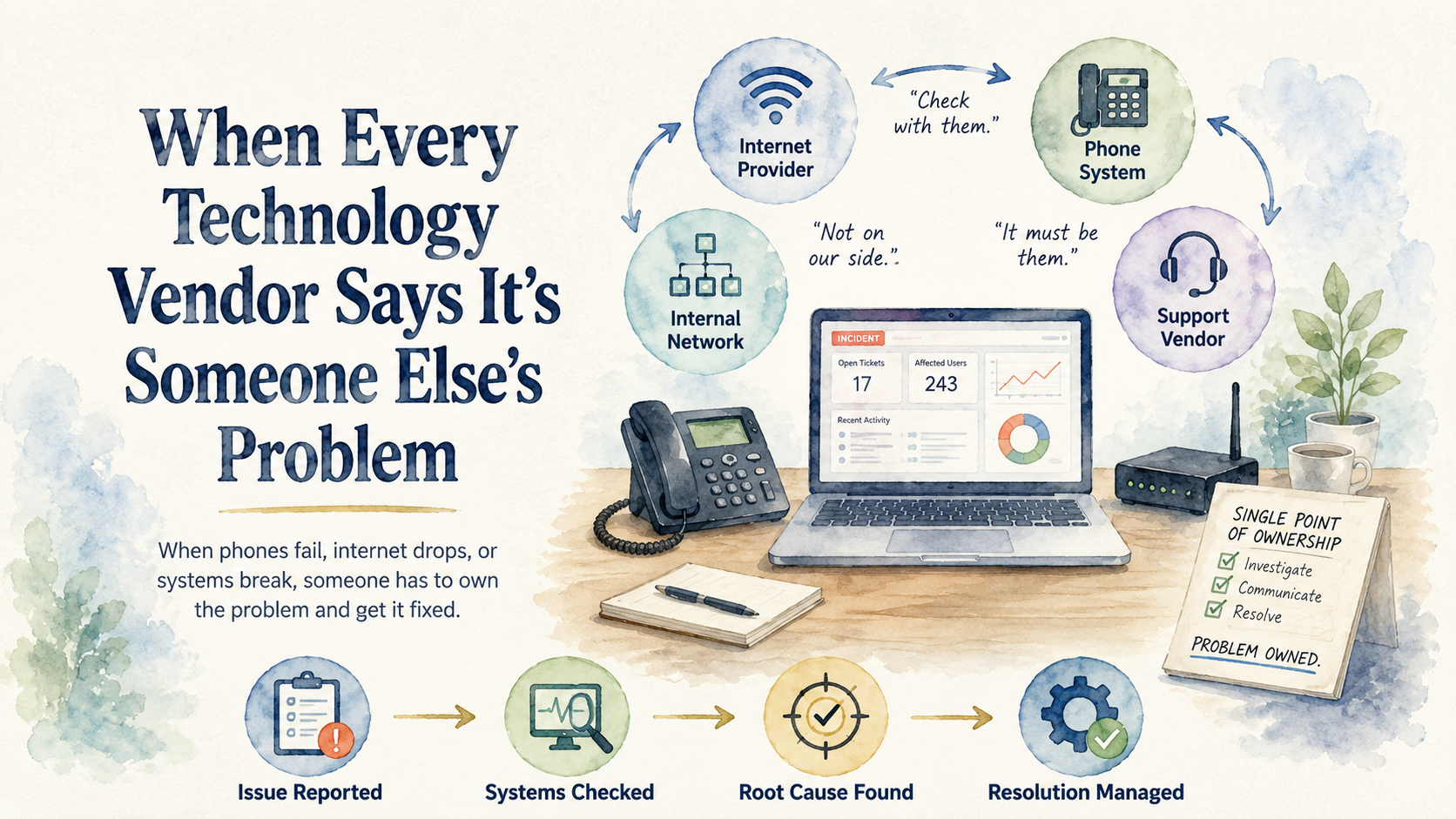
A business phone problem can look deceptively simple when calls start dropping or customers say they cannot get through. The phone provider checks its platform and reports that everything is online, while the internet provider finds no outage on the circuit. Meanwhile, the network installer confirms the equipment is powered and sees no obvious local failure.
All three vendors may be telling the truth, at least within the part of the system they can see. The phones still do not work.
This is the point where a technical incident turns into an operating problem. Someone inside the business has to carry an incomplete explanation from one support desk to the next, often while waiting through separate callbacks. That responsibility usually lands on an office manager or owner who has other work to do and no practical way to test the vendors' conclusions.
The problem is usually described as finger-pointing. That is understandable, but it misses the more useful diagnosis. Each vendor is trying to answer a narrow question: Is the product we support functioning? The business needs an answer to a broader one: Why can our employees and customers not complete a phone call?
Those are not the same question.
A Support Ticket Stops at the Product Boundary
Modern business systems depend on one another. A hosted phone system needs a working internet connection, but an internet connection that passes a basic availability test can still have intermittent packet loss or other conditions that affect calls. The local network and firewall also sit in the path. So do the physical phones, their configuration, and the provider's cloud service.
No single product support team necessarily has access to that entire path. A phone provider can inspect call records and its own service, but it often cannot inspect the customer's firewall or the internet carrier's circuit. The same limit applies in reverse: an internet provider can confirm connectivity without seeing what happened inside a failed call. A network vendor may know the configuration it installed, but not what has changed since then. Their conclusions are limited by their access and by the evidence included in the ticket.
The handoff between them creates another problem. An employee may tell the next vendor, "The phone company says it is the internet." That sounds decisive, but it leaves out the information needed to evaluate the claim. The next technician needs the time of a failed call and a precise description of what the caller experienced. It also matters whether every phone was affected and what the first provider actually observed.
Each shortened retelling removes context. By the third ticket, vendors are responding to one another's conclusions instead of looking at the original failure.
Someone Has to Own the Investigation
Useful incident ownership starts by keeping the business problem intact as it moves between vendors. The person coordinating the response should record the exact symptom with a timestamp and separate what happened from what each vendor thinks caused it.
For the phone issue, that might mean collecting two or three affected call times and determining whether the problem affects every phone or one location. The next step could be checking the phone provider's call-quality data against network monitoring for the same period. If the evidence points to the internet connection, the escalation to the provider now contains something more useful than "our phones are bad."
This does not guarantee that the first diagnosis will be right. It gives every vendor a common incident to investigate and creates a sensible next test when a theory is wrong.
The coordinator also needs enough authority and access to keep the investigation moving. A support call can stall because no one knows the account PIN, the network administrator is unavailable, or the business cannot identify who controls a piece of equipment. Those details feel administrative until service is down. Then they determine whether the next hour is spent testing the system or searching old email.
Coordination Is Different From Doing Every Repair
An accountable technical owner does not need to replace the internet carrier, phone provider, or software company. Specialized vendors remain useful because they understand their systems and have access that an outside party will not.
The difference is that responsibility for the business outcome no longer moves with each ticket. One person keeps the common timeline and determines what must be tested next. That person also verifies that service is restored under normal working conditions.
This is the incident-level consequence of a broader issue we addressed in Small Businesses Need an IT Owner. Technical knowledge can be purchased one task at a time. Context and accountability cannot. They have to remain with someone who understands how the pieces support the business.
That continuity also improves future incidents. If a particular network change causes phone trouble, the cause and resolution should become part of the company's technical record. The next person should not have to rediscover the relationship from the beginning. Recurring failures are much easier to recognize when they are treated as a history rather than a collection of unrelated tickets.
What to Fix Before the Next Outage
A business does not need a complicated incident-management program to improve this. Start with the phone system or another service whose failure would stop customer work.
For that system, document the provider and the person authorized to open a ticket. Record where administrative access is controlled and which upstream service it needs. There should also be one named person responsible for coordinating incidents that cross those boundaries. The role can be internal or outsourced, but it cannot be shared vaguely among everyone in the office.
Then review one recent problem that took too long to solve, reconstructing where the investigation stalled and what evidence was missing. If the first ticket lacked useful timestamps, decide how staff will capture them next time. Fixing that specific gap will do more for the next outage than adding another generic support phone number to a spreadsheet.
Palmetto Intelligence can serve as the technical point of ownership for small and mid-sized businesses that do not need a full internal IT department. We take responsibility for the working environment and coordinate specialized vendors when a problem crosses the line between systems.
When service fails, the most useful question is not which vendor deserves the blame. It is whether someone owns the path back to normal work.